
Who really owns your restaurant data – and how to make sure it stays useful

In this article
Restaurant data ownership isn’t just about which company’s name is on the database. It’s about whether the data stays usable – by your team, by the next person who inherits it, and by the AI tools your business will increasingly depend on. Most restaurant groups get the first part right and miss the rest entirely.
Most multi-site operators have spent the last few years arriving at the same conclusion: their data is one of their most valuable assets, and it’s scattered across more systems than anyone wants to count: POS, labour, reservations, inventory, reviews. The instinct is right – pull it together, own it, build something the business controls and can work with.
Where it gets expensive is the next question. How do I own my restaurant data?
A growing number of operators are weighing a custom-built data warehouse against a specialist restaurant analytics platform. The comparison almost always gets framed around control: surely building it yourself gives you maximum ownership?
It is a reasonable instinct but it is also where the most expensive mistakes get made. Here we break this down for you.
What does restaurant data ownership actually mean?
Start with the literal version. Where does your data physically live and who can read it? Most analytics providers use a multi-tenanted environment: your data sits on the same database as other customers’, logically separated but physically shared. For smaller operators, that’s fine. At enterprise level, the answer should be different.
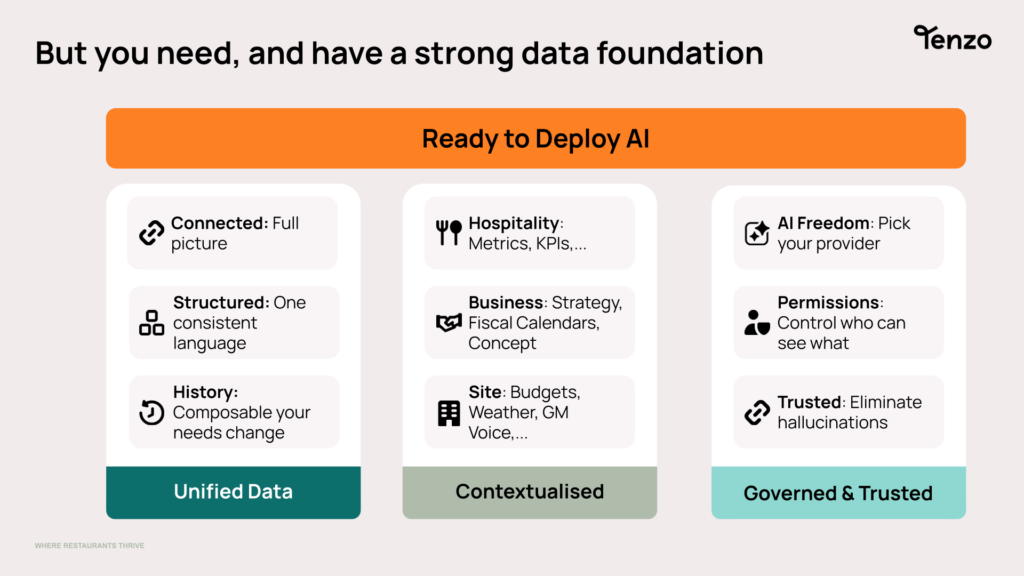
On Tenzo’s enterprise plan, your data sits on its own dedicated database instance. It is only your data, hosted in Tenzo’s AWS infrastructure but owned by you. That distinction matters: hosting is an operational convenience; ownership is a contractual right. If you ever want to move, we’ll facilitate the transfer to your own infrastructure or anyone else’s. We’ll write that into the contract.
But here’s the part most vendors won’t tell you: physical ownership is what almost everyone over-weights.
A database you own but can’t interpret isn’t an asset. It’s a liability with your name on it.
Data ownership details operators miss: the semantic layer
The semantic layer is the documentation, definitions and structure that explains what your data actually means. Think of it like inheriting a filing cabinet: unlabelled folders, versus one with a clear index, cross-references, and a guide to every document inside. The numbers are the same. The usability is completely different.
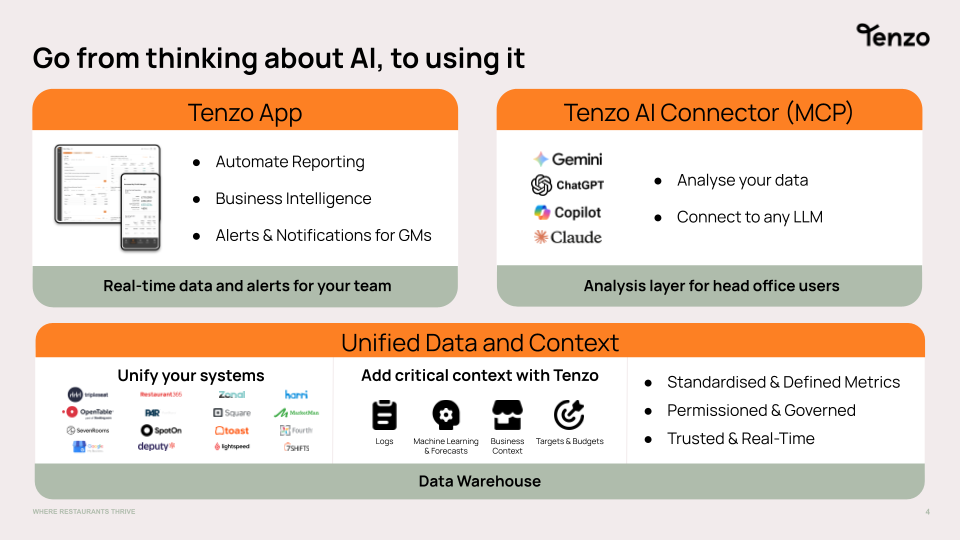
Tenzo’s data is organised into a clearly documented schema – consistent across every customer and data point, for example your POS, whether that’s Comtrex, Toast, Square, or Oracle. We publish the schema documentation and entity-relationship diagrams. It means any developer, any vendor, or any AI tool can pick up and use your data without a handover meeting.
In a world where operators are increasingly querying their data through AI tools, the value of that decision has compounded. A documented, consistent schema is exactly what a large language model needs to reason over your data accurately. Without it, AI either hallucinates or simply can’t answer. The semantic layer has gone from a ‘nice-to-have’ to the thing that determines whether AI can help you at all.
The critical point for anyone making this decision today: you can’t separate the data warehouse decision from the semantic layer decision. The way you structure and document your data is the same decision as whether your team will actually be able to use it. Deferring the semantic layer until “later” is how restaurant groups end up with a warehouse full of data nobody confidently queries.
Should you build your own data warehouse or use a platform?
The fear driving most operators towards a custom build is legitimate: if my data is structured in a vendor’s format, am I locked in?
You should never enter a technology relationship without understanding exactly how you’d leave it. But here’s the counter-intuitive part: the portability risk is typically higher with a custom build, not lower.
When you commission a consultant to build a bespoke warehouse – your own Snowflake instance, structured your own way – you own it. But it’s only usable to the extent that its schema and entity-relationship diagrams are documented. In practice, custom builds are documented for the team that built them and nobody else. When that developer moves on, the knowledge leaves with them. The next developer who inherits it won’t touch it, because they can’t see why the decisions were made.
This isn’t hypothetical. Experienced FDs at multi-site groups have gone down exactly this path – built their own Snowflake databases, structured their own way – and found themselves unable to reuse the work when the team changed. Moving on meant starting again.
A platform built around a public, standardised semantic layer flips that risk entirely. Because Tenzo’s data organisation is publicly documented, you could hand it to any developer or any vendor and they’d have clear instructions from day one. Other players in the ecosystem already pull data out of Tenzo into their own systems – precisely because the schema is clean, consistent, and identical across every POS. When your data structure is becoming a de facto standard in hospitality, portability stops being a leap of faith.

To build or to buy?
How Coffeeangel built their own BI reporting, but ultimately moved to Tenzo
How portable is your restaurant data if you want to leave?
When Tenzo facilitates a move off of our infrastructure, you leave with everything you need to be immediately operational elsewhere:
- Full schema documentation and an entity-relationship diagram – public, identical across all customers, so any developer can work with it from day one.
- A data dictionary mapping every field to its business meaning – including derived metrics and KPIs, so the definitions travel with the data rather than staying locked in someone’s head.
- Documentation of the ingestion pipelines from each source and the transformation logic layered on top – so the how is never a black box.
The test worth applying to any vendor you’re evaluating: ask them those three questions directly. If the answers aren’t clear and immediate, the ownership probably isn’t either.
What this means for multi-site restaurant operators
Pull this together and the choice looks different from the way it’s usually framed.
- A custom build gives you the feeling of maximum control and the literal title to a database. But its real usability depends entirely on documentation that rarely survives the people who created it. That’s the moment a “data asset” becomes a stranded liability.
- A platform built around a public, standardised semantic layer gives you ownership that holds up under pressure: a dedicated database you control, a documented structure any third party can pick up, and genuine portability if you ever leave.
Owning your restaurant data is the easy part. Owning data that stays usable – through a vendor change, a developer’s departure, and the shift to AI – is the part worth designing for from the start.
Ready to take control of your data?
Talk to the team today to learn more.

FAQs
Your most asked questions
Restaurant data ownership has two components: physical ownership (which company’s infrastructure your data lives on and whether you have direct read access to it) and semantic ownership (whether the data is documented clearly enough to be usable by your team, your vendors, and AI tools without specialist knowledge). Most operators focus on the first and underinvest in the second, which is where the real risk lies.
A semantic layer is the documentation and structure that explains what your data actually means – the difference between a table full of numbers and a system anyone can pick up and use. In restaurant analytics, a well-built semantic layer means your sales figures, labour metrics, and KPIs are defined consistently across every site and every system. Without it, your data warehouse is only as useful as the people who built it, and only for as long as they stay.
For most multi-site restaurant groups, a purpose-built platform with a public, standardised schema offers more genuine portability than a custom build – not less. Custom warehouses are typically documented for the team that built them and become unusable when that team moves on. A platform with publicly documented schema can be handed to any developer or any vendor and used immediately. The flexibility argument for custom builds has also weakened significantly with the arrival of AI tools that can generate bespoke reports directly from a clean, documented data schema.
Ask any analytics vendor three questions before you sign: Is my schema documented and publicly available? Do I get my own dedicated database at enterprise level? What exactly do I leave with if we part ways – and can you write that into the contract? If the answers are not clear and specific, the ownership terms probably are not either.
Tenzo’s MCP integration connects your restaurant analytics data to large language models like Claude, allowing you and your team to query performance data in plain English – without writing SQL or building custom reports. Because Tenzo’s data schema is clean, consistent, and publicly documented, AI tools can reason over it accurately and generate bespoke reports, dashboards, and board pack views on demand. Find out more about Tenzo’s MCP integration.
Enterprise customers leave with full schema documentation and entity-relationship diagrams, a data dictionary mapping every field and derived metric to its business meaning, and complete documentation of ingestion pipelines and transformation logic. Everything you need to be operational with another provider from day one. We are happy to write that commitment into the contract.