








What is AI for hospitality? The operator’s guide

In this article

Get advanced insights...
...in less time! Talk to the team about how AI can help your business growth.
Book a demoAI for hospitality means using machine learning to join up the data a hotel or restaurant group already has – POS, labour, occupancy, reviews. It turns that data into an answer a GM can act on immediately, instead of a report that lands a week later. It sits on top of your existing systems rather than replacing them.
Hospitality has moved past the “should we look at AI” conversation. A survey of more than 400 hotel technology decision-makers found 85% plan to put at least 5% of their IT budget toward AI tools this year. 82% expect AI use to increase across their organisation within the next twelve months. The open question for most operators now isn’t whether to invest. It’s where AI for hospitality actually changes a P&L, versus where it’s just a dashboard with a chatbot bolted on.
This shift is happening for operators across hospitality broadly – hotels, multi-site groups, multi-concept operators – not restaurants alone. The operational shape differs by segment. A hotel group manages room revenue and multiple F&B outlets under one roof; a restaurant group is managing covers and sales etc. across sites. But the underlying data problem is the same one. Performance data spread across a POS, a labour scheduler, a PMS and countless other systems. Add a review platform, and a handful of spreadsheets that never talk to each other, and that’s the real challenge.
What is hospitality analytics?
Hospitality analytics is the practice of collecting operational data – sales, labour, occupancy, inventory, reviews, etc – from across a hospitality business. It turns that data into insight that informs a decision. Think of it as the difference between a car’s dashboard and a mechanic’s diagnostic report. A dashboard tells you your speed and fuel level; a diagnostic report tells you why the engine’s running rough and what to fix. Reporting shows you what happened. Insights tells you why it happened and what to do next.
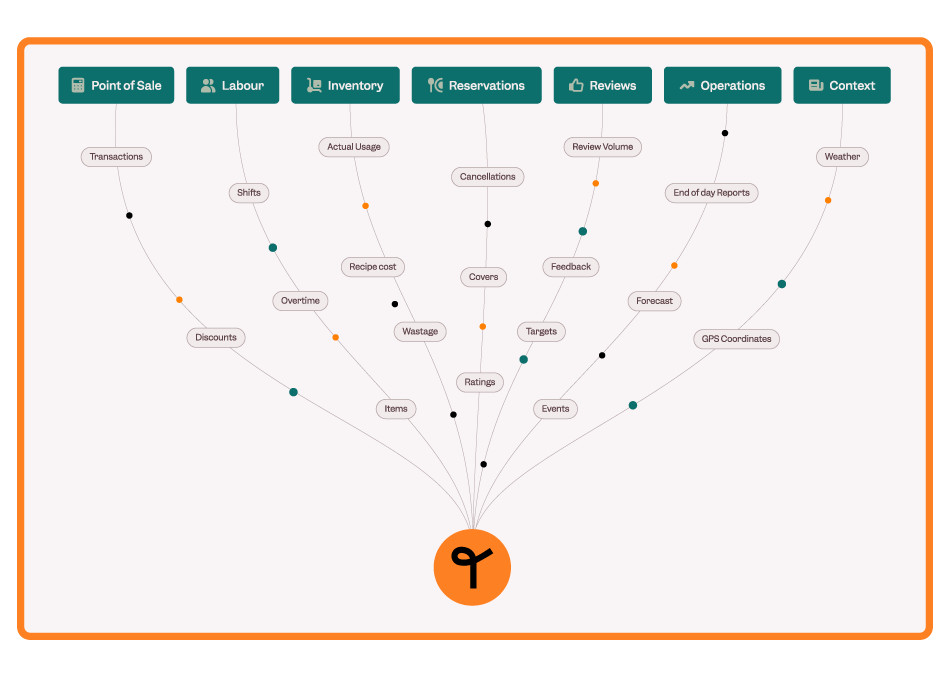
For a multi-site hotel or restaurant group, that data typically comes from a property management system or POS, a labour scheduling tool, inventory or procurement software. Increasingly it also comes form review platforms (Google, TripAdvisor, SevenRooms), and unstructured sources like manager end-of-day reports. On their own, each source is a partial picture. A hotel F&B director looking only at POS data can see that Saturday breakfast revenue dropped. But they can’t see whether that’s a staffing gap, a menu problem, a booking pattern shift or a mixture of reasons – not without pulling in labour and occupancy data alongside it.
Why AI for hospitality matters now
Two things changed to make this a prevalent topic rather than a future one. First, the number of connected systems in a typical hospitality tech stack has grown. Most multi-site operators are now running somewhere between five and fifteen separate tools. Second, large language models, LLMs, have made it possible to ask a plain-English question across all of that data at once. That beats the time spent on exporting multiple CSVs and building a complex report by hand.
The result is that AI for hospitality isn’t really about automation for its own sake. It’s about compressing the time between “something’s off” and “here’s why, and here’s what to do about it.” A GM who used to wait for a weekly report to see a labour variance can now ask the question directly. The answer comes back joined across POS, scheduling, and review data in the time it takes to type the question.
Key use cases
Demand forecasting
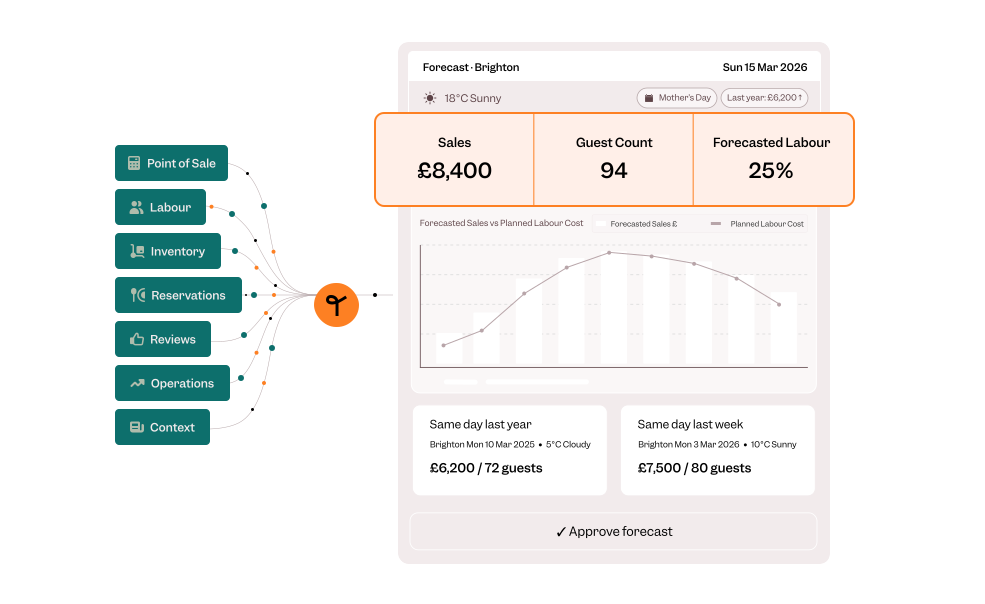
Demand forecasting is the practice of predicting covers, occupancy, or footfall ahead of time. It uses historical patterns plus external signals – weather, local events, seasonality, booking pace. It’s the hospitality equivalent of a weather forecast: not a guarantee, but a probability-weighted picture good enough to plan around. Get it right and you order the right stock, schedule the right headcount, and staff for the Saturday you’re actually going to have – not the one your rota template assumes.
The multi-site element is what makes this hard to do by hand. A group running a dozen sites across different markets is effectively running a dozen different forecasts. Each one is shaped by local weather, local events, and local demand seasonality – which is exactly the kind of pattern-matching AI-driven forecasting tools are built to do at scale. Tenzo’s demand forecasting is one example of this applied specifically to hospitality operations.
Labour optimisation
Labour is usually the largest controllable cost line in hospitality. It’s also the one most exposed to bad forecasting – overstaff a quiet Tuesday and margin leaks quietly all week; understaff a busy Saturday and it shows up in service and reviews. Q1 2026 data across roughly 5,000 hotels showed labour cost per occupied room rose 1.8% year over year. Hours per occupied room actually fell 2.3%. That combination – doing more with fewer hours per room – is the pattern that separates disciplined labour management from simply cutting costs.
Optimisation here means matching scheduled hours to forecast demand at the shift level, not the week level. A hotel’s front-of-house needs on a Sunday morning differ from a Friday dinner service in ways a flat weekly budget can’t capture. Tenzo’s MCP can be used as a labour optimisation tool, tying schedules directly to the demand forecast rather than to last year’s rota.
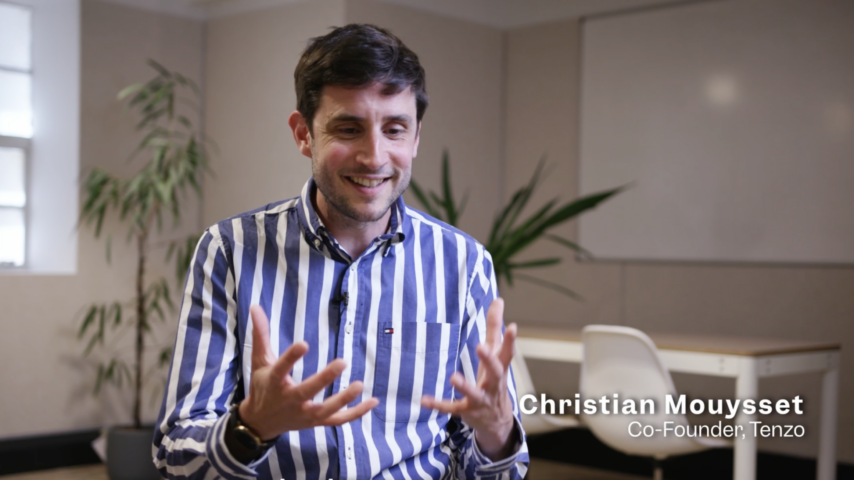
Our founder Christian walks through how AI for hospitality can explore the issue of labour productivity below.
F&B / cost control
For hotels specifically, F&B often behaves like several small businesses under one roof – restaurant, bar, room service and events. Each has different margins, labour intensity, and demand patterns. Reporting on “hotel F&B” as a single number hides which of those revenue centres is actually performing. Breaking performance down by outlet and day part (breakfast behaves nothing like dinner, commercially) is what turns a single blended F&B margin into something you can actually act on.
Generator and Freehand – a group running 19 hotels and 40 F&B outlets across 10 countries and 2 continents – offered a useful illustration of the scale problem here. Before consolidating onto a single analytics layer, head office reconciled performance across sites manually in Excel. The Group Operations Manager there saw reporting time cut by 75% – time the team then spent acting on insights instead of compiling them.
Guest & experience insight
Guest sentiment – reviews, feedback, complaints – is usually the most under-used data source in a hospitality tech stack. Partly that’s because it’s qualitative and doesn’t sit neatly next to sales and labour numbers.
The value shows up when it’s cross-referenced. A dip in review scores on certain nights is far more useful once you can see it alongside labour deployment or covers on those same nights, rather than reading review scores in isolation.
Manager end-of-day reports work the same way for internal context. A shortfall that looks like an anomaly in the numbers often has a one-line explanation – “delivery didn’t arrive,” “short-staffed for a no-show” – sitting in a logbook entry that most reporting tools never connect back to the transactional data.
Analytics vs AI for hospitality – what’s the difference
The two terms get blurred constantly, partly because most modern analytics platforms now have some AI baked in.
Analytics is the process of organising and interpreting data to answer a question – usually a question you already know how to ask. A monthly labour report, a sales-by-site dashboard, a forecast model: all analytics, in the traditional sense, even without any AI involved.
AI for hospitality now manifests in many different forms: in kitchen robotics, automated check-in, chatbots for guest services. What we’re talking about here is more specific: AI applied to insights and reporting, the layer that makes sense of the data a hotel or restaurant group already has. On top of that analytics foundation, it mainly does two things. It lets you ask questions in plain English rather than building a report first, and it can join multiple data sources at once to answer a “why” question a static dashboard was never designed to answer. Think of analytics as the filing system and AI as the assistant who can actually search it for you on demand, rather than you having to know which drawer to open.
Practically, this means the two aren’t competing categories – AI sits on top of an analytics foundation, and is only as useful as the data underneath it. A hospitality group with clean, connected data across POS, labour, and reviews gets real value from an AI layer. The same AI layer, pointed at fragmented, siloed data, produces confident-sounding answers that are wrong just as often as they’re right.
Choosing a hospitality analytics platform
Once you’ve decided to invest in this category, the practical evaluation comes down to a handful of questions.
Does it connect to your operational tech stack?
A platform that doesn’t integrate with your PMS, POS, and labour scheduler is a standalone reporting tool, not an analytics layer. Every integration gap is a category of question it can’t answer. This matters more for hospitality than most sectors, since a single group can be running different POS or PMS systems across different sites – especially after acquisitions.
Are qualitative data sources brought in?
Manager notes, event flags, and guest feedback carry the context that explains anomalies in the transactional numbers. Platforms that only ingest structured data – sales, labour hours – miss the “why” half of most operational questions. Tenzo’s logbook feature means we always consider valuable contextual information.
Build, generic BI, or purpose-built platform?
This is usually the question for larger groups. A tool like Power BI is a generic business intelligence platform – flexible, but it needs a data warehouse and in-house data engineering before it produces anything useful for hospitality specifically. Revenue-management specialists like IDeaS solve a narrower, deeper problem – pricing and forecasting – very well, but don’t extend into labour, F&B, or guest sentiment. Purpose-built hospitality analytics platforms sit in between. They’re less configurable than generic BI, more operationally complete than a single-purpose revenue tool, and typically live in days rather than months because the hospitality-specific integrations already exist.
Can it scale with you?
A platform that works for three sites needs to keep working – without a growing admin burden when you hit ten or thirty sites. Multi-brand or multi-concept groups should check specifically how the platform handles differing menus, service models, or POS systems across the portfolio.
For a deeper, evaluation-focused comparison of platforms – including pricing models – our restaurant analytics software guide goes into this in more detail.
Tenzo for hospitality – integrations breadth
Data fragmentation is the constraint that shows up repeatedly across every use case above. Forecasting, labour, F&B, and guest insight all depend on connecting sources that, in most hospitality groups, have never been introduced to each other. This is the practical role integrations play: not a features checklist, but the thing that determines whether any layer of analytics or AI sitting on top actually has enough to work with.
Tenzo connects to 90+ systems across POS, labour, inventory, reviews, reservations and more too. That spans the systems common across both restaurant and hotel operations, including Lightspeed, Zonal, Oracle Micros/Opera, and Square. For multi-concept and multi-brand groups running different POS systems across sites – often the result of acquisitions rather than choice – that breadth is what turns a portfolio of disconnected tools into one reportable estate.
On the AI side, Tenzo’s MCP – the connector that links your data to whichever AI model you already use – connects that same unified data layer directly to Claude, ChatGPT, Copilot, or Gemini. Questions can be asked in plain English rather than built as a report first.
At JKS Restaurants, a 20-site group operating across the UK and the USA, complex queries that once landed with the head of FP&A now take about an hour of Claude’s time. Those queries used to take anywhere from a few hours to a week to turn around, according to Finance Director Christina Nuval. As she puts it, what changed wasn’t the data – it was who could access it. Insights that used to sit with one person now belong to everyone, no data analysis background required.
For hotel and multi-concept groups specifically, this looks like: hotel F&B performance broken down by outlet and day part, labour scheduled against a live demand forecast rather than last year’s rota, and manager logbooks queryable alongside the transactional data – with the option to layer AI on top once the data underneath is actually connected.
See all our integrations here
Conclusion
Hospitality analytics and AI aren’t separate investments – one is only as valuable as the data foundation underneath it. Operators getting real value from this category aren’t the ones with the most sophisticated AI. They’re the ones who’ve connected their tech stack first, and are using AI to ask sharper questions of it.
If you want to see what that looks like against your own portfolio, across hotels, restaurants, or a mixed estate, book a demo and we’ll walk through what’s possible with your specific data.
FAQs
Frequently Asked Questions
Hospitality analytics is the practice of connecting operational data – sales, labour, occupancy, inventory, guest reviews – from across a hospitality business. It turns that data into insight that changes a decision, rather than just reporting what already happened.
AI is mainly used to ask plain-English questions across multiple connected data sources at once. It can join labour, covers, and review data to explain why a metric moved, rather than just reporting that it moved. It works best on top of a clean, connected data layer; pointed at fragmented data, it produces confident answers that are often wrong.
Restaurant analytics is hospitality analytics applied specifically to restaurant operations – covers, menu margin, front- and back-of-house labour. Hospitality analytics is the broader category, extending to hotels, multi-concept groups, and businesses managing several revenue centres under one roof. The data problem is the same across both; the specific metrics and revenue centres differ.
Four things in particular: integration coverage across the specific POS/PMS systems in use, the ability to break down performance by revenue centre and day part, treatment of qualitative data as a first-class source, and the ability to scale without a growing admin burden as the estate grows.
Tenzo connects the systems a hospitality group already runs – POS, PMS, labour, reviews – into one reportable layer. For hotels specifically, we solely report on F&B performance. It lets teams ask plain-English questions across that data through Claude, ChatGPT, Copilot, or Gemini via Tenzo’s MCP. It’s built specifically for hospitality’s mix of structured and qualitative data, rather than adapted from a generic BI tool.