

Restaurant roles and responsibilities: How operational structure drives better performance data

In this article
Behind every smooth service and profitable week is a team of people who know exactly what they’re responsible for, a management structure that supports them, and a solid operational system built on clean, reliable data.
The restaurant groups that track performance across sites, forecast demand, and make faster decisions do so because their operational data is trustworthy. That trustworthiness starts with role clarity: the right people owning the right processes, consistently, every day.
In this guide, we’ll walk you through the core roles that make a restaurant operation run and why clear ownership of those roles directly impacts the quality of your data. See how platforms like MarketMan and Tenzo give restaurant operators the operational structure and performance intelligence to run a tighter business at any scale.
What are the core roles in a restaurant operation?
Restaurant teams typically sit across three layers: culinary, operations, and management. In smaller restaurants, one person can wear several hats. In larger groups, these responsibilities become separate. Knowing what each role owns is the starting point for an efficient, accountable operation.
Executive Chef / Head Chef
The creative and operational lead for everything leaving the kitchen. Responsible for menu development, recipe documentation, food quality, and maintaining food cost targets. In multi-site groups, this role often sits at headquarters, setting culinary standards that all locations follow. MarketMan enables Chefs to standardise recipes within a cookbook so that dishes are consistent throughout all locations.
Sous Chef
The head chef’s operational right hand so they manage day-to-day kitchen operations, ensure recipes are executed to spec, and bridge kitchen leadership and the line team.
Kitchen Manager
Particularly important in high-volume environments, this role focuses on the operational and administrative side. Ordering, inventory management, scheduling, and supplier coordination. When this role is well-defined and well-supported, it has a direct impact on the accuracy of your inventory data and on every downstream report your operations team relies on.
Restaurant Manager / General Manager
Oversees the full operation, both front and back of hous, thereupon they take accountability for the customer experience, team performance, and financial targets.
Operations Manager / Regional Manager
In multi-site groups, this role sits above individual GMs. They ensure consistency across locations and translating business strategy into operational execution therefore Tenzo’s site benchmarking enables managers to track KPIs for all sites in a single dashboard, identifying top performers and sharing best practices across the organisation.
Purchasing Manager / Inventory Lead
More common in larger operations, this person manages supplier relationships, oversees the ordering process, and works closely with the kitchen to keep stock optimised. Accuracy here is non-negotiable: every correctly reconciled invoice, every properly logged delivery, feeds the cost data that informs performance analysis.
Finance / Accounts
Responsible for invoice approval, payment processing, food cost reporting, and financial reconciliation. Accuracy improvements in the operational layer, like better invoice scanning and automated cost matching, reduce the reconciliation burden and improve the reliability of the numbers this team works with.
Why role clarity matters more as you scale
Role clarity matters because accountability requires ownership. When it’s unclear who places orders, tracks waste, or updates recipe costs, these tasks either happen inconsistently or not at all. And inconsistency in your operational processes produces inconsistency in your data.
The cost shows up in predictable ways. As inventory that doesn’t match purchase records, recipe costs that drift without anyone catching them, food cost variance that erodes margins without a clear cause. Food cost variance is one of the most significant drivers of margin erosion in restaurant operations.
For multi-site groups, this multiplies when even a small inconsistency in how a role is defined across ten locations means ten versions of the same problem. This is where the power of MarketMan and Tenzo comes together.
How restaurant management software supports each role
For Chefs: Recipe Management and Costing
MarketMan gives culinary teams the infrastructure to build, cost, and update every dish accurately. Recipe costs are tied to live ingredient prices, so calculations reflect what ingredients actually cost today, not six months ago.
In multi-site environments, recipes built at HQ flow to all locations in view-only mode, enforcing consistency without constant oversight. AI-assisted recipe building accelerates the documentation process, helping chefs cost new dishes against current supplier prices without manual cross-referencing.
For Kitchen Managers and Purchasing Teams: Inventory and Ordering
AI-powered inventory tools have changed what’s possible for purchasing and kitchen management teams. Rather than manual counts and intuition-based ordering, teams now have near-real-time stock tracking, variance flagging, and order recommendations. These are based on current inventory, sales velocity, and par levels.
This is also where the Tenzo integration becomes tangible. When MarketMan inventory and purchasing data is captured accurately, that data flows directly into Tenzo. There it works alongside your POS, labour, and sales data to give operations teams a complete picture of performance.
For Operations and General Managers: Visibility and Performance
For GMs on the ground, Tenzo delivers real-time sales and labour intelligence accessible from any device. All without needing to run a report or pull an export. The food cost dimension of that picture flows from MarketMan. Together, the two platforms give site-level managers what they need to make decisions in the moment, not at the end of the month.
For regional and operations managers, Tenzo’s cross-site benchmarking lets you identify where food costs are running high, where inventory variance is worst, and where the gap between theoretical and actual GP is widest, without relying on each site to compile its own reports. MarketMan’s role-based access structure ensures the data underlying those comparisons is being managed by the right people at each location.
For Finance Teams: Invoice and Payment Accuracy
When invoices are scanned, matched, and reconciled automatically, the data flowing into financial reporting is more reliable. Additionally, the time spent on manual reconciliation drops significantly. MarketMan’s AI invoice scanning matches deliveries to purchase orders and automatically updates ingredient costs. It also flags discrepancies before they become margin problems.
From operational structure to performance intelligence
The practical case for combining MarketMan and Tenzo is this. One platform captures what’s happening in your operation; the other tells you what it means for your performance.
MarketMan is the AI-powered inventory management platform that connects purchasing, inventory, recipe building, and AP management, all kept accurate in real time. Tenzo is the intelligence layer aggregating that data alongside POS, labour, and sales data. It surfaces insights so operators can plan staffing and inventory with confidence rather than guesswork.
Operators who invest in operational structure: clear role ownership, disciplined inventory practices, and accurate recipe costing, get compounding returns from their analytics platform. Every correctly captured count, every reconciled invoice, and every updated recipe cost make the performance data more reliable and the decisions based on it more confident.
Restaurants that understand their numbers deeply and maintain the discipline to keep them accurate are the ones that turn that accuracy into consistent, measurable performance gains.
The MarketMan and Tenzo integration is built to help you do exactly that.
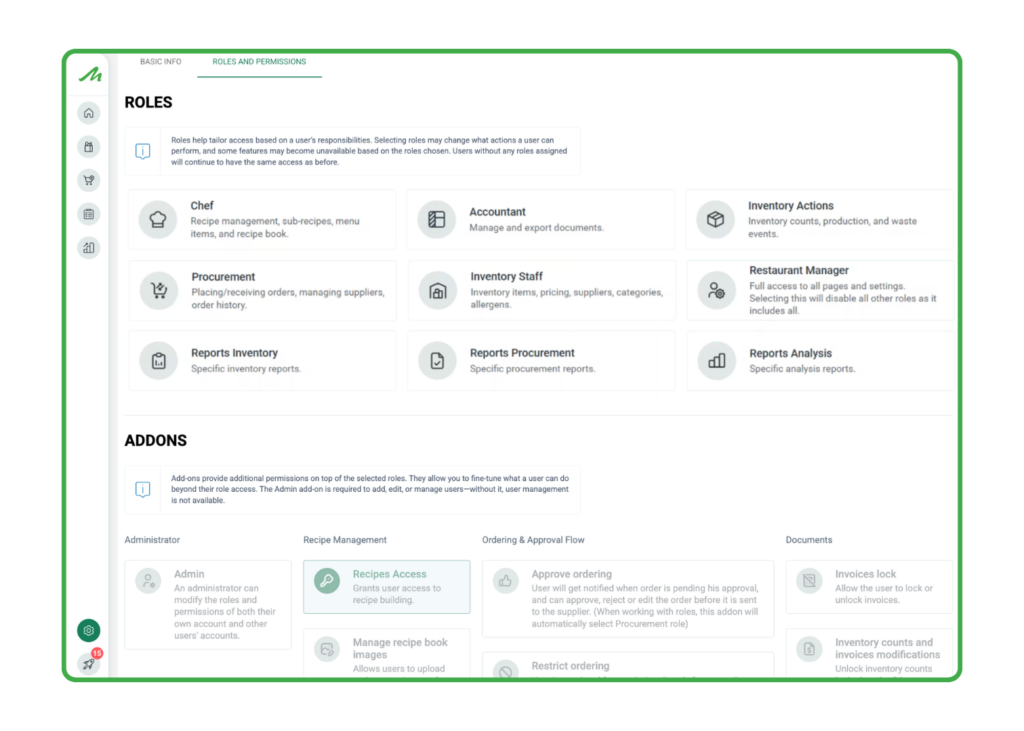
MarketMan’s roles and permissions: the right access for every team member
MarketMan’s roles and permissions system is designed to map directly to the kind of operational hierarchy described in this guide. Rather than giving every user access to every feature, the platform allows you to assign pre-built roles and customise permissions with add-ons. Each team member sees what’s relevant to their job, and nothing they shouldn’t be acting on.
The Chef role gives culinary teams full access to sub-recipes, menu items, and the recipe book, with view access to the dashboard. They can build and manage the full recipe architecture without access to purchasing, reports, or financial settings. In chain environments, HQ chefs can create and manage the recipes that flow as view-only to each location, enforcing consistency at scale.
Add-on permissions allow administrators to extend access where specific roles require it: a payment add-on for finance users, an allergens editor for the team member responsible for compliance, a reports analysis role for managers or analysts who need data visibility without full operational access. This is the kind of granular, configurable structure that growing operations need.
Ready to see it in action? Book a demo with the MarketMan and Tenzo teams today.