The Two Biggest Challenges Fractional Consultants in Hospitality Face (And How to Solve Them)

Fractional consulting is one of the fastest-growing engagement models in business today, and the hospitality industry is no exception. Hotel groups, restaurant operators, and hospitality management companies increasingly recognise that they don’t always need a full-time hire. They need senior-level expertise, deployed flexibly, at the right moment. For experienced hospitality operators, that creates real opportunity.
But building a sustainable fractional consulting practice in hospitality is harder than it looks. Most fractional consultants run into the same two structural problems: a lack of data and performance visibility caused by fragmented technology and siloed systems, and constrained capacity that limits how much they can actually do about it. Understanding both, and how they compound each other, is the first step to solving them.
In this blog, we will discuss what a fractional consultant in hospitality is, why data visibility and capacity are the two most common barriers to delivering impact, how these challenges reinforce each other, and how Tenzo is built to solve both.
What Is a Fractional Consultant in Hospitality?
A fractional hospitality consultant is an experienced professional who provides senior-level expertise to hospitality businesses on a part-time or project basis. Unlike a freelancer or contractor, a fractional consultant typically holds a defined strategic role, such as fractional COO, fractional Revenue Director or fractional Director of Operations, and operates as an embedded member of the leadership team for a set number of hours or days per week.
The model benefits both parties: hospitality businesses access executive-calibre talent without the cost of a full-time hire, and consultants build flexible, high-value practices across multiple clients, whether that is a boutique hotel group, a multi-site restaurant brand, or a growing serviced apartment operator.
Challenge 1: Lack of Data and Performance Visibility
The Fragmented Tech Problem in Hospitality
Hospitality businesses typically operate across a wide range of disconnected systems: point-of-sale platforms, labour management tools, inventory systems, and guest review platforms, among others. Each holds a piece of the picture. None of them talk to each other in a meaningful way.
For a fractional consultant stepping into an engagement, this fragmentation creates an immediate and serious problem. There is no single source of truth. Performance data is scattered across spreadsheets, extracted manually from individual platforms, and often out of date by the time it reaches the people who need to act on it. Making confident, evidence-based recommendations becomes significantly harder when the underlying data is incomplete, inconsistent, or simply inaccessible.
Data Silos Undermine Strategic Decision-Making
The silo problem goes beyond inconvenience. When sales data from the POS, labour costs, stock levels from inventory, and guest sentiment from reviews all live in separate systems with no unified view, patterns are missed and decisions are made on partial information. A drop in profitability might be a labour scheduling issue, a stock wastage issue, or a guest experience issue driving lower return visits. Without clean, connected data across all of these sources, it is difficult to know which, and nearly impossible to prove the impact of any intervention.
For fractional consultants, whose value lies in identifying problems quickly and driving measurable results, poor data visibility directly limits what they can deliver. Time that should go towards analysis and strategy instead goes towards data gathering and reconciliation.
Visibility Is a Data Infrastructure Problem
The lack of performance visibility in hospitality is not a knowledge problem. Fractional consultants have the expertise to interpret data and act on it decisively. The issue is that the data infrastructure in most hospitality businesses was not designed to provide a coherent, real-time view of performance across the operation. Fragmented systems and manual processes create noise where there should be signal.
Until that infrastructure problem is solved, even the most capable fractional consultant is working with one hand tied behind their back.
Challenge 2: Capacity Constraints That Cap Impact
The Operational Reality of Fractional Work in Hospitality
Fractional consulting in hospitality is high-touch by nature. Clients engage fractional talent because they need strategic thinking and hands-on execution, not passive oversight. Whether it is turning around a struggling F&B operation, supporting a pre-opening team, or driving revenue strategy across multiple sites, delivering at that level across simultaneous engagements requires both expertise and operational infrastructure.
Most fractional consultants lack the latter. Over time, they accumulate a patchwork of tools, templates, and processes, but these are typically ad hoc, inconsistent, and not built for scale. Proposals get rebuilt from scratch. Onboarding frameworks vary by client. Deliverables are tracked in spreadsheets. Administrative work quietly consumes hours that should be spent on high-value delivery.
Why Capacity Is a Leverage Problem
Capacity, in this context, is not simply a question of available hours. It is a question of leverage. A fractional consultant without standardised systems can only scale by working more hours, which defeats the purpose of the model. A consultant with the right infrastructure can serve more clients at a higher quality level without proportionally increasing their workload.
The ceiling most fractional consultants hit is not set by their expertise. It is set by the absence of systems designed for how they actually work.
How the Two Challenges Compound Each Other
The data visibility problem and the capacity problem do not exist in isolation. They make each other significantly worse.
When performance data is fragmented and hard to access, a disproportionate amount of a consultant’s time goes towards gathering and reconciling information before any real analysis can begin. That leaves less capacity for the strategic work clients are actually paying for. And when capacity is already stretched across multiple engagements, there is little room to tackle the underlying data infrastructure issues that are causing the problem in the first place.
The result is that fractional consultants end up firefighting rather than transforming. They deliver value, but not at the scale or speed they are capable of. Breaking the cycle requires addressing both constraints together, not separately.
How Tenzo Helps Fractional Hospitality Consultants Solve Both Problems
Tenzo is a platform built specifically for the hospitality industry, designed to address data visibility and capacity as a unified challenge rather than two separate ones.
A Single View of Performance Across the Operation
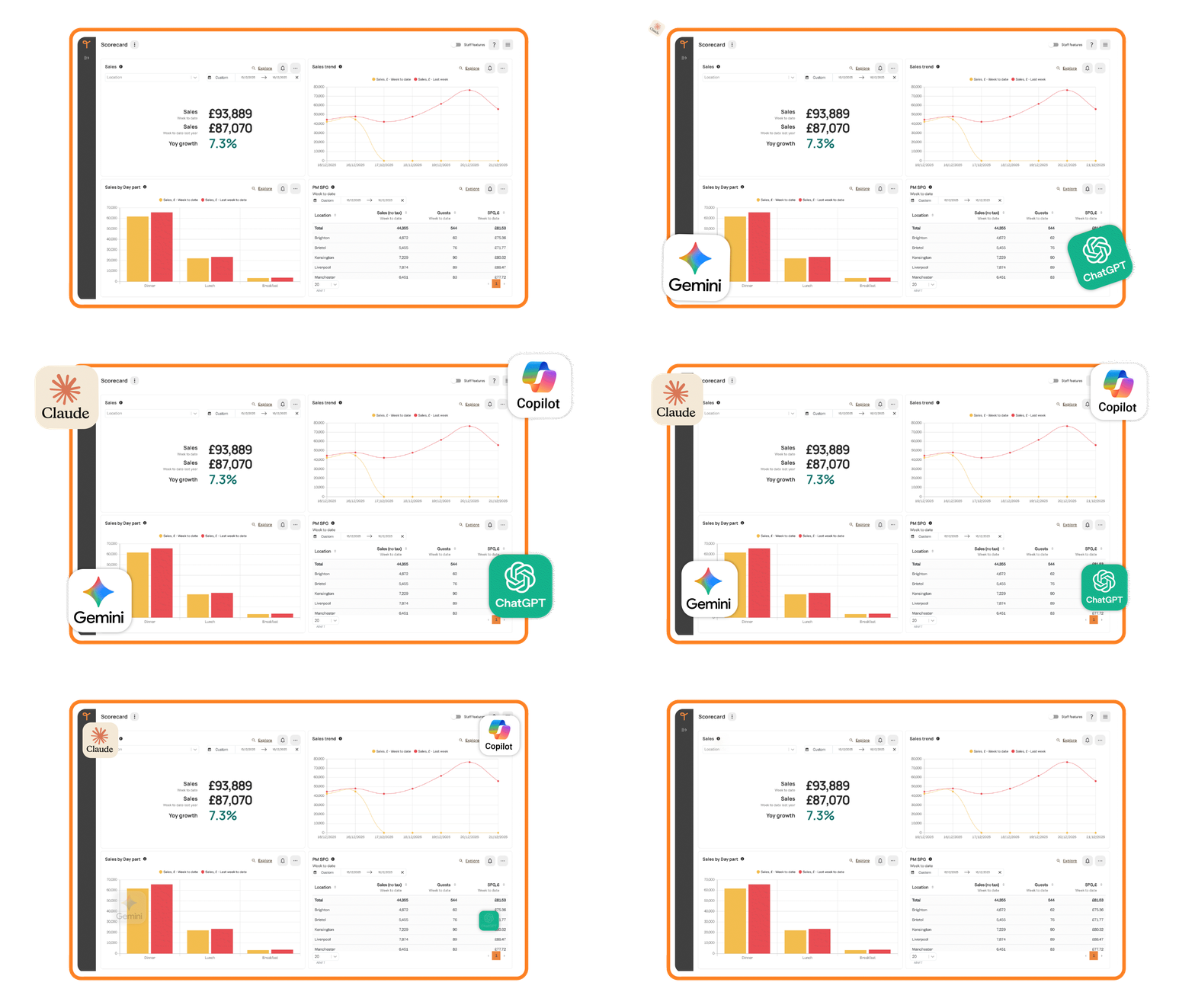
On the visibility side, Tenzo connects the fragmented data sources that fractional consultants typically have to piece together manually, bringing together POS, labour, inventory, and guest reviews into a single, unified view. Rather than extracting data from individual systems and reconciling spreadsheets, consultants get a real-time picture of performance across the whole operation in one place.
This changes the pace and quality of fractional engagements. Time spent on data gathering shrinks dramatically. Time available for analysis, diagnosis, and strategic delivery expands. Consultants can move faster, communicate findings more clearly, and demonstrate impact more convincingly.
Operational Infrastructure for Fractional Engagements
On the capacity side, Tenzo provides the engagement infrastructure that most fractional consultants have to build themselves: standardised onboarding frameworks, proposal tooling, and delivery support designed specifically for the fractional model.
The result is that administrative overhead shrinks and time spent on high-value client work expands. Consultants can take on more engagements, deliver more consistently, and build a practice that compounds over time rather than resetting with each new client.
Built for the Fractional Model, Not Adapted from Something Else
Most tools fractional consultants rely on were designed for freelancers, agencies, or full-time employees. Tenzo is built from the ground up for the specific dynamics of fractional work in hospitality: multiple simultaneous engagements, fragmented client data environments, senior-level delivery expectations, and the need to demonstrate measurable impact quickly.
FAQs
Frequently Asked Questions
AI agents for restaurants can take on many forms such as customer service and enquiries or staffing and purchasing management for example. Alternatively, it can be a software that can pull from multiple parts of your operation – sales, labour, stock, reviews, reservations – and answer questions about them in plain English. Rather than building a report and searching it for the number you need, you ask directly, and the agent draws the answer from wherever it lives, whether that’s a single site or across a whole group.
GEO refers to optimising content so that AI-powered search tools, such as Google’s AI Overviews, ChatGPT, and Perplexity, surface it accurately in generated responses. As more hospitality professionals use AI to research service providers and business topics, content that is structured, authoritative, and clearly sourced is more likely to be cited and recommended.
At minimum, fractional hospitality consultants benefit from a unified performance data platform, standardised proposal and contract templates, a client onboarding framework, and a system for tracking deliverables across engagements. Tenzo provides the data infrastructure and operational tooling as part of its platform.
There are many different variants but most tools marketed as AI agents for restaurants are a chat interface sitting in front of a single data source – ask about labour, and that’s all it can see. Tenzo’s MCP connects your entire tech stack into one unified model, so an answer can draw on all of it at once. It also holds your own business context and works inside AI tools your team already uses, like Claude, ChatGPT, Gemini, or Copilot, rather than asking you to learn a new interface.
Fragmented tech means performance data from POS, labour, inventory, and review platforms is spread across multiple systems with no single source of truth. Consultants must manually extract, clean, and reconcile data before they can begin analysis. In engagements where time is limited, this overhead is costly. It delays insight, reduces the time available for strategic work, and makes it harder to demonstrate clear, measurable impact.
The Fractional Consulting Market in Hospitality Is Growing
The demand for fractional consulting is increasing as hospitality businesses look for flexible, cost-effective access to senior talent, particularly as the sector continues to face pressure on margins, talent availability, and operational complexity. But the infrastructure to support fractional consultants, both in terms of data visibility and operational capacity, has not kept pace with that growth.
Tenzo is built to close that gap: not as a generic tool adapted for hospitality, but as a platform designed around the specific challenges fractional consultants in the sector face every day.
For fractional consultants navigating the data visibility and capacity challenges that limit most practices, Tenzo offers a structural solution to both.
Tenzo supports fractional consultants in hospitality with unified performance data, engagement infrastructure, and the tools to build a scalable, high-impact practice. Learn more at gotenzo.com.