How UK heatwaves really affect restaurant sales 2025–2026
In this article
- Does a heatwave actually increase restaurant sales?
- Why do July and August heatwaves hurt more than they help?
- Are all hospitality venues affected equally in a heatwave?
- Does outdoor seating make a material difference to heatwave performance?
- Which days of the week perform best during a heatwave?
- The June exception: what made late June 2025 different?
- What happened during the June 2026 heatwave?
- How should operators interpret year-on-year heatwave data?
- What this means for operators planning ahead
Hot weather does not reliably mean better sales. Across six heatwave periods and approximately 500 venues in London and the Southeast, the typical venue traded below the prior week in three of those periods – and was essentially flat in the rest. The one consistent winner: venues with meaningful outdoor space, which outperformed their indoor counterparts in every single period.
Every summer, the same assumption does the rounds: hot weather is good for hospitality. People go out more, spend more, linger longer. The terraces are full. The tills are ringing.
The data tells a more complicated story.
Tenzo analysed daily sales data from approximately 500 hospitality venues across 118 operator groups in London and the Southeast, covering six heatwave periods across three consecutive summers: June–August 2025, and May and June 2026. The findings challenge our presumptions – and have some practical implications for how operators plan, staff, and forecast during summer heat events.
Does a heatwave actually increase restaurant sales?
The honest answer is: sometimes, for some venues, under specific conditions.
The most reliable lens is week-on-week – how did venues perform against their own trading the week immediately before? Year-on-year figures are frequently distorted by what happened to be going on in the prior-year comparison period (more on that below).
On that measure, the picture across all six periods is striking. The combined week-on-week median across every day of the week is 0.0%. The typical venue, on any given heatwave day, neither gained nor lost relative to its own prior week. A minority of venues did significantly better – but for most, the heat didn’t move the needle.
Two periods were clearly positive. Two were materially negative.
| Period | Median WoW sales change | % of venues positive WoW |
| May 2026 (27–31 May) | +1.49% | 52% |
| June HW1 (16–21 Jun 2025) | -1.34% | 48% |
| June HW2 (27–30 Jun 2025) | +4.75% | 60% |
| July 2025 (9–14 Jul) | -4.01% | 42% |
| August 2025 (11–15 Aug) | -3.34% | 43% |
| June 2026 (19–28 Jun) | +1.54% | 52% |
If trading was tough during the July or August heatwaves last year, the data bears that out. Fewer than half of venues in the dataset beat the prior week during both those periods. June – particularly late June – is where heat most reliably translates into genuine uplift.
Why do July and August heatwaves hurt more than they help?
There are a few factors at work here, and most operators will recognise them.
City departure. During sustained summer heat, a significant proportion of London’s population leaves – coast, countryside, or simply out of the city for the weekend. Saturdays are consistently one of the weaker heatwave days by positive rate in our data, which is consistent with a weekend exodus stripping footfall from city-centre venues at exactly the wrong time.
Commuter suppression. Extreme heat on the Underground discourages commuting, which hits lunchtime trade hard in central locations. The neighbourhood restaurant may see little impact; the city-centre one loses its lunch covers.
Novelty fatigue. The first proper hot weekend of summer is an occasion – people make plans, book tables, head out. By July and August, sustained heat has become less of an event and more of an inconvenience. The June 2026 data illustrates this clearly: a 10-day heat event produced strong Sundays and Mondays but a weak midweek as consumer enthusiasm ran in pulses rather than continuously.
Outdoor concentration. The longer a heat event runs, the more trade concentrates at venues with outdoor space and the more indoor operators feel the squeeze. More on this below.
Are all hospitality venues affected equally in a heatwave?
No – and this is probably the most operationally important finding in the data.
The spread of outcomes during heatwave periods is wide, but it skews negative in July and August. In those months, more than half of all venue-days in the dataset came in below the prior week. Around one in five venues recorded a drop of more than 20% against the week before – in every period, without exception.
| Period | Share of venues down >20% WoW | Share of venues up >10% WoW |
| May HW | 19% | 36% |
| June HW1 | 17% | 29% |
| June HW2 | 12% | 39% |
| July HW | 19% | 25% |
| August HW | 18% | 25% |
| June 2026 HW | 14% | 31% |
That persistent 14–19% who drop more than 20% tend to share characteristics: indoor-only, reliant on commuter footfall, or a format that doesn’t translate well to heat-driven demand.
June 2026 sits between the extremes – better than July and August, not as strong as late June 2025. Its modest positive median (+1.54%) masks the sharpest outdoor-indoor divide in the entire dataset.
Does outdoor seating make a material difference to heatwave performance?
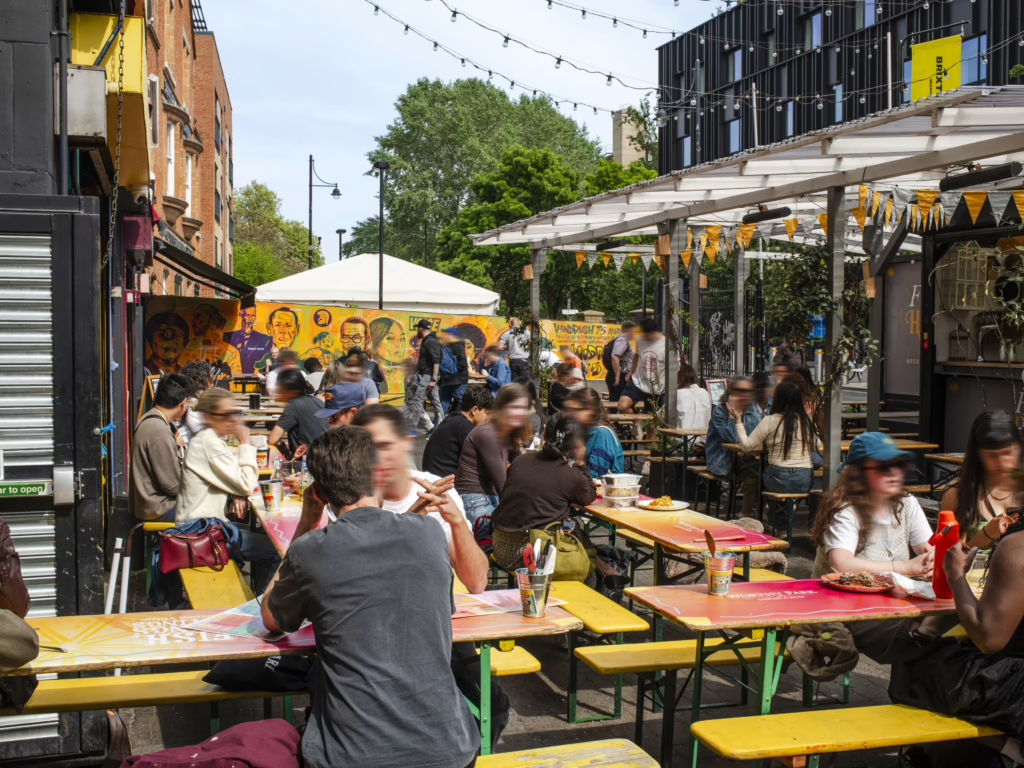
Yes – it is the single strongest predictor of heatwave performance in this dataset.
We classified 112 of the 686 venues analysed as outdoor-capable – meaning they had a terrace, meaningful outdoor seating, or sat adjacent to a river, canal, beach, or park. The remaining 574 were primarily indoor. Across all six periods:
| Metric | Outdoor venues (median) | Indoor venues (median) |
| Sales YoY | +5.76% | +0.49% |
| Sales WoW | +3.39% | -0.92% |
| Transactions WoW | +3.1% | -1.4% |
Outdoor venues averaged +3.39% against the prior week, with 55% coming in positive. Indoor venues averaged -0.92%, with fewer than half finishing positive. The transaction gap is even larger – outdoor venues served more covers; indoor venues served fewer.
June 2026 produced the widest outdoor-indoor gap of any period in the dataset. Outdoor venues were up nearly 9% week-on-week; indoor venues were essentially flat. A sustained heat event doesn’t distribute trade evenly – it concentrates it at the venues people actively want to be in.
One nuance worth noting: indoor venues show a slightly higher spend per head during heatwaves on a year-on-year basis. The customers who do come in tend to be there for a purpose – a planned occasion rather than an impulse visit – and they spend accordingly. Fewer covers, but often a higher average transaction value.
Which days of the week perform best during a heatwave?
Wednesday and Thursday are the most consistently positive across all six periods – the highest proportion of venues beating the prior week, and the strongest mean week-on-week uplift.
Sunday is the highest-variance day in the dataset. It produced both the best single-day result across three summers (Sunday 28 June 2026: +11.29% week-on-week, 70% of venues positive) and one of the worst (Sunday 31 May 2026: -10.81%, though almost entirely a bank holiday comparison effect). Operators near parks, rivers, or anywhere with genuine leisure draw tend to outperform significantly on heatwave Sundays. Without that, it can go the other way.
Monday shows a consistent extension effect: when heat carries through a weekend, the following Monday tends to outperform expectations. This was most pronounced in June 2026, where Monday 22 June came in at +10.27% week-on-week with nearly two-thirds of venues positive. It’s happened across multiple periods now and is worth building into rota planning.
Saturday generates the highest absolute revenue of any day but is also the most polarised. The best heatwave Saturday in the dataset (+7.81% week-on-week in late June 2025) and some of the worst non-distorted daily figures both fall on Saturdays. Performance on a heatwave Saturday is perhaps the clearest indicator of whether a venue has the physical setup to benefit from summer heat – or not.
The June exception: what made late June 2025 different?
June HW2 – 27–30 June 2025 – remains the standout period across three summers. Nearly 60% of venues beat the prior week. Saturday 28 June was the strongest single day across all 2025 heatwave periods.
Several factors converged:
- A Friday-to-Monday window, capturing weekend leisure spending at its natural peak
- No bank holiday in the immediately preceding week distorting the comparison
- Early enough in summer that outdoor dining still carried genuine novelty
- A short, defined heat event rather than a 10-day grind
Average transaction value also moved during June HW2 – up 3.33% year-on-year, which is unusual. Most heatwave periods don’t shift spend per head at the median level. When conditions are right, they do.
This is the blueprint for a heatwave that genuinely benefits hospitality. It is not the norm.
What happened during the June 2026 heatwave?
June 2026 (19–28 June) ran for 10 days – the longest single period in the dataset – and produced a pattern distinct from anything in the previous two summers.
The overall picture was modestly positive (+1.54% week-on-week, 52% of venues positive), but the day-by-day breakdown shows how uneven a 10-day heat event is for the industry.
| Day | Date | Median WoW sales change | % of venues positive WoW |
|---|---|---|---|
| Friday | 19 Jun | -1.33% | 48% |
| Saturday | 20 Jun | -2.16% | 46% |
| Sunday | 21 Jun | +9.01% | 63% |
| Monday | 22 Jun | +10.27% | 64% |
| Tuesday | 23 Jun | -2.54% | 45% |
| Wednesday | 24 Jun | -4.17% | 43% |
| Thursday | 25 Jun | +1.39% | 51% |
| Friday | 26 Jun | -0.23% | 50% |
| Saturday | 27 Jun | -3.65% | 43% |
| Sunday | 28 Jun | +11.29% | 70% |
Two strong Sundays, a standout Monday, and a soft midweek in between. The final Sunday was the best single Sunday across the entire dataset.
The year-on-year picture for June 2026 looks negative overall (-2.18% median) – but this is a comparison artefact, not a trading signal. June 2025 contained two heatwave periods, so the prior-year baseline is unusually elevated. The week-on-week figures are the reliable read.
The outdoor-indoor gap in June 2026 was the largest of any period analysed: outdoor venues up nearly 9% week-on-week, indoor venues essentially flat. A longer heat event appears to progressively concentrate trade at outdoor venues as the market polarises over time.
How should operators interpret year-on-year heatwave data?
With caution – particularly for July, August, and June 2026.
The July 2025 year-on-year figures look strongly positive mid-week, but that’s because the comparison period falls in June 2024 – a different trading month entirely. August 2025 is split in the opposite direction because the comparison week in August 2024 was itself a heatwave. And June 2026 compares against a June 2025 that contained two heatwave episodes.
In all three cases, the year-on-year figure reflects as much about the comparison period as it does about actual trading performance. A strong year-on-year on a hot Wednesday in July may be an easy comparison, not a genuine uplift. A negative year-on-year in June 2026 may simply be a heatwave measured against another heatwave.
Week-on-week is the cleaner measure during a heat event. How did you trade against your own prior week? That’s the question worth asking.
What this means for operators planning ahead
A heatwave is not a free revenue event. For most venues – particularly indoor, city-centre, or commuter-dependent locations – it is more likely to produce a neutral or below-prior-week outcome than a genuine uplift.
The practical implications are operational. Forecasting that assumes a heatwave uplift may lead to overstaffing and waste. Venues without outdoor capacity should plan defensively during July and August heat events. The businesses that consistently benefit are those structurally set up to serve outdoor, leisure-driven demand – and even those venues see significant variability depending on the timing, duration, and timing within the summer season.
Three things the data suggests are worth building into summer planning:
- A June heatwave is not the same as a July or August one. Early-summer heat, particularly over a weekend window, is the most reliably positive scenario. By late summer, consumer behaviour during heat events shifts – city departure increases, novelty declines, and the market concentrates further in outdoor destination venues.
- Duration matters. The June 2026 10-day period shows how a longer heat event progressively polarises the market. By the end of a sustained event, the outdoor-indoor gap is larger than at the start. If you are midweek-dependent or primarily indoor, a 10-day heatwave is harder than a four-day one.
- Sunday and Monday are the highest-upside days for operators who can capture them. When heat persists through a weekend, the extension effect into Monday is real and material. It requires being staffed and ready for it.

Get prepared for the next heatwave with AI forecasting.
See how Tenzo tracks sales performance across your sites in real time.
Still curious?
Frequently asked questions
Not reliably. Tenzo’s analysis of approximately 500 hospitality venues across six heatwave periods between 2025 and 2026 found that the combined median WoW change for every day of the week is 0.0% – the typical venue neither gains nor loses against its own prior week during a heatwave. Two periods (late June 2025 and June 2026) produced clearly positive WoW outcomes; July and August 2025 were materially negative, with median WoW declines of around 3–4%.
Yes, significantly. Across all six periods, venues with meaningful outdoor seating, terraces, or proximity to parks, rivers, or canals averaged a WoW sales median of +3.39% (55% positive) compared with -0.92% (48% positive) for primarily indoor venues. June 2026 produced the largest single-period gap: outdoor venues averaged +8.95% WoW versus indoor at +0.46%. Outdoor capacity is the single strongest structural predictor of heatwave performance in this dataset.
Wednesday and Thursday show the most consistently positive outcomes, with 53% of observations positive on a year-on-year basis and the highest mean WoW returns across the combined six-period dataset. Sunday is the highest-variance day, producing both the best (+11.29% WoW in June 2026) and worst (-10.81% WoW in May 2026) single-day performances. Monday shows a reliable extension effect when heat persists through a weekend.
Several factors converge. By July and August, prolonged heat has become less of a social occasion and more of an inconvenience, reducing the novelty-driven outdoor dining effect. City-departure patterns on weekends are more pronounced. Commuter suppression on the Underground reduces lunchtime central London trade. Early June heatwaves, particularly when they fall on a Friday-to-Monday window, capture consumers at the peak of their summer leisure appetite.
Less reliable than many operators assume. The July 2025 YoY is distorted by a comparison period in a different month (June 2024). August 2025 YoY is distorted by a 2024 heatwave baseline. June 2026 YoY compares against June 2025, which contained two heatwave episodes. In all three cases, week-on-week comparisons are the more honest measure of what actually happened during the heat event itself.
It varies by period. June HW2 – the strongest in the dataset – saw 60% of venue-day observations positive WoW. July and August saw fewer than 43%. June 2026 was 52%. Across all six periods, a consistent 14–19% of observations recorded WoW declines of more than 20%, representing a structural minority of venues – typically enclosed, commuter-dependent, or format-constrained – that are consistently disadvantaged by heat regardless of the event.
This analysis is based on anonymised, aggregated trading data from approximately 500 hospitality venues across 118 operator groups in London and the Southeast, covering six heatwave periods between June 2025 and June 2026. All performance figures are computed as the median or mean of individual per-venue percentage changes, not as comparisons of pooled revenue totals. No individual business results are identified. Tenzo collects this data via its analytics platform, which connects directly to operators’ point-of-sale systems across the UK.
Ready to dive into your data?
Chat to our team and get the most out of your data with Tenzo.