AI demand forecasting for restaurants: How it works and why it matters
In this article

Dive into your data...
Looking to get the most out of your business' data? Let's chat!
Request a demoAI demand forecasting for restaurants uses historical sales, covers, and contextual data – weather, events, seasonality – to predict how busy each shift will be, at the daypart level, across all your sites. Done well, it reduces the two most expensive planning failures in hospitality: over-staffing on quiet nights and under-staffing on peak ones. The downstream effects on labour cost, food waste, and purchasing are where the real ROI lives.
Monday morning. You’re throwing away £400 of prep that didn’t move over the weekend. Friday night, you turned away three tables because you were at capacity and two staff members called in sick – which you hadn’t anticipated because nothing in your plan flagged it as an unusually busy night.
Both problems have the same root cause: you didn’t know what was coming.
Forecasting has always existed in restaurants – experienced GMs have always made educated guesses, and the methods have evolved from gut feel to rolling averages to machine learning. The question is whether AI demand forecasting makes it materially better – and in what ways. This post focuses on what AI forecasting specifically enables that manual methods don’t, what it makes possible downstream, and the mistakes that undermine it even when the tool is working correctly.
The one distinction most forecasting tools get wrong
Before anything else, this is worth saying clearly: covers is the right planning input. Revenue is a financial output. They are not the same thing.
Two shifts can produce identical revenue but require completely different resourcing. A quiet night where a few tables order heavily and linger, takes different management from a high-volume night where covers turn quickly and average spend is lower. Labour planning anchored to revenue doesn’t catch this.
Covers – specifically, the number of guests expected per daypart – determines floor capacity, kitchen throughput, FOH headcount, and prep quantities. Revenue should sit alongside it as a projection, not replace it as the forecasting anchor.
When evaluating forecasting tools, ask specifically whether the output includes covers by daypart. If the answer is revenue only, the tool is optimised for financial reporting, not operational planning.
How does AI improve on manual forecasting?
Most experienced GMs can forecast reasonably well for their own site. That intuition is genuinely valuable. The problem is that it doesn’t scale, it doesn’t self-correct, and it’s not consistent across sites.
- Scale. A GM pattern-matches against the shifts they’ve personally worked. AI holds a much larger variable set simultaneously: multiple years of historical covers, weather correlations, local event data, school term dates, promotions history, and the specific behavioural fingerprint of each site. The result is the ability to surface patterns that humans reliably miss – recurring anomalies that affect a single day of the week after a specific event type, for instance, which almost never get captured in manual GM forecasts.
- Consistency. Manual forecasting quality correlates with GM experience. Your most experienced GM at your longest-running site probably forecasts well. Your newest GM at a newer site probably doesn’t. AI applies the same analytical rigour to every site regardless of who’s managing it – so your group-wide accuracy reflects your best GMs, not your average ones.
- Continuous learning. Manual forecasting doesn’t update. A GM who miscalibrated a forecast this Friday has to consciously remember to adjust next Friday. AI models improve continuously from actuals – every shift that comes in refines the next forecast. Tenzo’s forecasts are typically 30–50% more accurate than traditional four-week averages, and that gap widens the longer the model runs on your data.
That said, the GM still matters. If there’s roadworks outside the restaurant, only the GM knows how that affects Saturday night. That’s why the best forecasting setup combines the model’s baseline with a GM approval process – Tenzo data shows that GM engagement with forecasts increases accuracy by a further 5%.
What good forecasting enables downstream
The forecast itself isn’t where the value is. It’s what it makes possible.
- Labour planning anchored to a number, not a hunch. When you know how many covers you expect at 7pm on Saturday, you schedule the right FOH and BOH headcount for that window specifically. The staffing decision becomes a calculation from a reliable input rather than a judgment call. Over-staffing is an avoidable labour cost. Under-staffing costs you service quality, review scores, and spend per head – the data on what happens to reviews on understaffed high-cover nights is covered here.
- Prep set to forecast, not last week’s actuals. Most food waste in restaurants isn’t a function of ordering too much – it’s prepping too much based on incorrect assumptions about a shift. A covers forecast gives your kitchen a reliable number to prep to, tightening the gap between what’s prepped and what’s used.
- Purchasing driven by expected demand. The same logic applies one step upstream. Purchasing anchored to a reliable forecast means ordering closer to what you’ll actually need. Tenzo users typically see a 2–8% reduction in cost of goods sold once forecasting is embedded in the purchasing process.

How Tenzo’s forecasting helped Fitz Group lower their Prime Costs by 3% points
Aggregate your tech stack and get real results.
Common mistakes that undermine forecasting
Even operators using AI forecasting tools don’t always get the most from them.
- Forecasting at the wrong granularity. A weekly site-level forecast isn’t useful for operational decisions. You need daypart-level forecasts – morning, lunch, dinner – because that’s the level at which labour scheduling and prep planning actually work.
- Not updating with actuals fast enough. A forecast running on last month’s data is a stale forecast. The model needs current data – ideally daily – to stay accurate. This is a process discipline as much as a technology question.
- Using revenue forecasts to drive labour decisions. Covered above, but worth repeating: covers is the right planning input. Tools that only output revenue produce systematically wrong staffing plans.
- Ignoring qualitative inputs. Manager logs and known events are forecasting signals that don’t appear in transactional data. When a GM notes that a local food festival is on this weekend, that’s information the model should use. When it doesn’t, the forecast misses a predictable spike.
- Treating the forecast as fixed. A forecast made on Monday should be refined as the week develops – as reservations come in, as weather changes, as same-day signals emerge. The best use of AI forecasting is a continuously updating probability, not a single weekly number.
How Tenzo approaches demand forecasting
Forecasting accuracy improves significantly when the model can draw on a wider picture than sales history alone.
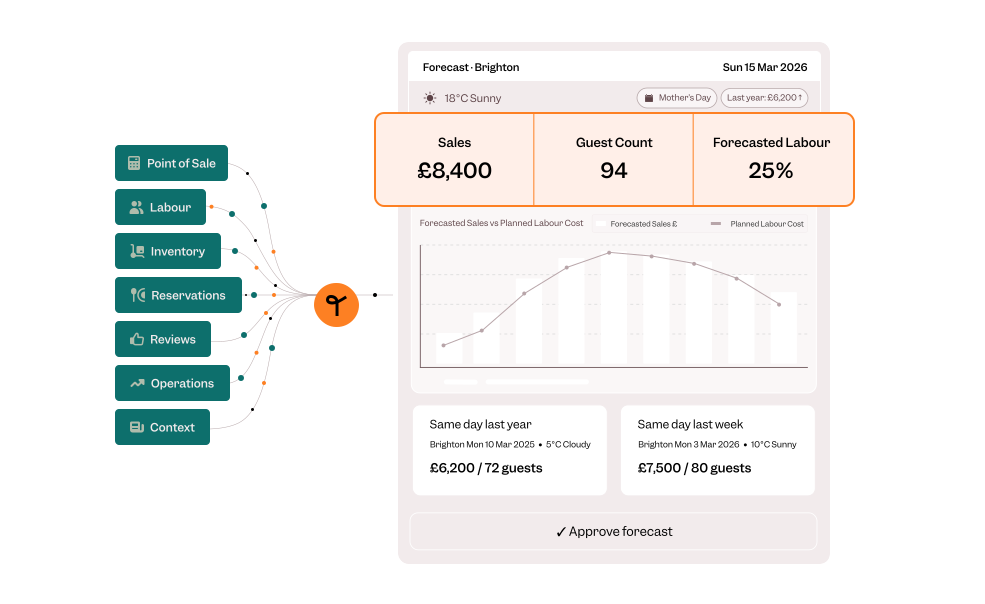
Tenzo’s MCP connects covers, revenue, labour, and manager logs – so a forecast isn’t just pattern-matching on POS data. It can factor in that a specific collaboration menu drove +£5.30 per cover on already-busy Friday nights. It can factor in the qualitative context your team is capturing daily in their end-of-day logs, which is often the most specific near-term predictor of demand. That context is what turns a reasonable forecast into a reliable one.
Tenzo’s forecasting integrates directly with your existing POS and scheduling tools, so the forecast flows into the planning layer rather than sitting as a separate number someone has to manually translate into a rota.
The goal of AI demand forecasting isn’t to eliminate uncertainty. It’s to shrink the range of that uncertainty to the point where your staffing, prep, and purchasing decisions are consistently sound, not occasionally lucky.

See what forecasting accuracy looks like with your own site data…
…and watch your bottom line grow!
FAQs
Frequently Asked Questions
AI demand forecasting analyses historical covers and revenue – typically across two or more years – alongside contextual variables like weather, local events, day of week, school term dates, and seasonality. The model identifies patterns in how demand has responded to combinations of those variables historically, and uses them to predict how busy each upcoming shift is likely to be. The output is a shift-level covers and revenue forecast by site, updated continuously as new actuals come in.
Accuracy depends on data quality and breadth. Tenzo’s forecasts are typically 30–50% more accurate than traditional four-week rolling averages. The harder cases – unusual events, extreme weather, new sites without historical data – are where even good models have wider error margins. The practical measure isn’t perfect accuracy; it’s whether the forecast variance is small enough to make staffing and prep decisions from confidently.
Demand forecasting predicts covers – guests expected per shift – which is the right driver for operational planning (staffing, prep, purchasing). Revenue forecasting predicts how much money a shift will generate, which is right for financial planning and P&L projection. Good forecasting software produces both, but covers should be the primary operational input. Tools that only forecast revenue tend to produce wrong staffing plans because they don’t account for the difference between a high-spend-low-volume night and a high-volume-moderate-spend one.
At minimum: 12 months of consistent POS data broken down by covers and revenue at shift or daypart level. More useful: two or more years of data, weather correlations, local event records, reservation data, and manager log entries capturing qualitative context – promotions, events, operational changes. The more complete the picture of what shaped past demand, the more accurate the model’s predictions. Data that sits in disconnected tools or has been inconsistently recorded limits reliability regardless of how sophisticated the algorithm is.
It works for single sites, but the benefit scales with size. A single site generates enough data to build a reasonable forecasting model within 12 to 18 months. A multi-site group generates that data faster, and the model can learn across sites rather than from one alone. For a single-site operator, the bigger gains often come from downstream effects – better prep quantities and smarter purchasing – rather than the scheduling precision that matters most at scale.
The link is prep quantities. Most food waste isn’t a function of ordering too much – it’s prepping too much relative to actual shift volume. When prep is anchored to a reliable covers forecast rather than last week’s actuals, you prep closer to what you’ll use. This reduces both physical waste and the cost of emergency reorders when stock runs short.