









AI labour optimisation for restaurants: scheduling smarter without the guesswork

In this article
- Where does restaurant labour cost actually leak?
- Labour optimisation is a precision problem, not a reduction problem
- What AI labour optimisation actually does
- Why manager logs are the missing piece in labour analysis
- What good labour optimisation looks like week to week
- How Tenzo approaches AI labour optimisation
AI labour optimisation for restaurants reduces cost by identifying where hours are being deployed inefficiently – not by cutting headcount. The typical sources of labour overspend are structural over-scheduling, same-day agency cover, and silent no-show absorption – none of which require fewer staff to fix. They require better visibility, earlier in the week, before the cost is already locked in.
Most ops directors have a reasonable suspicion about AI labour optimisation: that it’s a polished way of saying “cut staff.” It’s worth addressing that directly, because the two things are different problems with different fixes.
AI labour optimisation is a scheduling precision problem – not a headcount problem. The question it answers isn’t “how many fewer people can we get away with?” It’s “are the people we already have scheduled in the right places, on the right shifts, at the right times?”
For most multi-site groups, the answer to that question is: not consistently. And the gap between consistent and inconsistent scheduling precision, across an estate, is a meaningful cost – without a single redundancy. This post explains where that cost lives, what AI does to surface and close it, and how labour optimisation can improve both P&L and service quality at the same time.
Where does restaurant labour cost actually leak?
Most labour overspend doesn’t come from one obvious source. It accumulates from several smaller ones that are individually easy to miss and collectively significant.
Structural over-scheduling
Rota templates get set. Then they don’t get reviewed. A site that needed six FOH staff on a Saturday dinner two years ago might need five today – or seven – depending on how the business has evolved. Templates that are set too high and left untouched become a permanent cost structure that never gets interrogated, because no individual week looks dramatically wrong.
This is one of the most common sources of labour overspend across multi-site groups, and one of the hardest to spot from a single week’s labour report. The signal is consistency: if a site is running slightly over plan almost every week, the template is the likely culprit – not a one-off event.
Same-day agency and overtime cover
When a team member calls in sick, the manager fills the gap with agency or overtime. Across a quarter, it adds up. For what this pattern looks like in the data – including the cost multiple of agency versus standard hourly rate – see how operators are using AI to find labour inefficiencies.
No-shows absorbed silently
A team member doesn’t show up. The GM makes it work, logs it, moves on. The labour report for that day looks fine – or even under – because the hours weren’t used. But the service was compromised. Review scores dip. Spend per head drops when the floor is understaffed. The cost shows up elsewhere, but not in the labour column where you’d look for it. How GM logs connect to COL% spikes is covered in detail here.
Under-staffing on peak shifts
Labour optimisation isn’t only about overspending – it’s about deploying your labour budget to buy the outcomes it should be buying. An understaffed Friday dinner has a measurable effect on review scores and spend per head, with a real cost in repeat visits and reputation. See the full video analysis below:
Labour optimisation is a precision problem, not a reduction problem
Most labour cost discussions in restaurants end up in the same place: how do we reduce the percentage? That framing conflates two different problems.
One is genuine overspend – deploying more hours than the shift requires. The fix is better scheduling, better forecasting, and earlier visibility of variance.
The other is misalignment – deploying hours in the wrong places, on the wrong shifts, so your labour spend isn’t buying the service quality it should be. More bodies on a quiet Tuesday lunch when you need them on a busy Friday dinner isn’t a headcount problem – it’s a distribution problem.
AI labour optimisation addresses both. Neither requires a single redundancy to fix. They require better data, earlier in the decision cycle, so the scheduling choices that determine cost are made with more information.
What AI labour optimisation actually does
Flags variance from plan before it becomes a cost
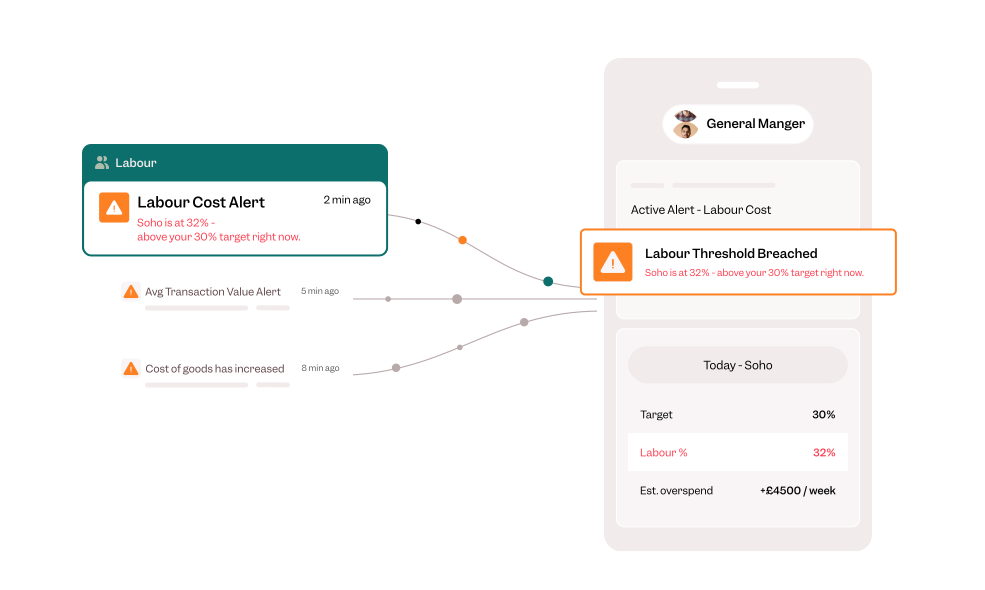
AI surfaces the sites and shifts running above or below plan during the week, not at month end when it’s already in the P&L. An ops director who knows on Wednesday that two sites are trending over can still do something about it. One who finds out at the next finance review cannot.
Distinguishes structural patterns from one-off events
A site that ran over by £800 because of an unexpected private event is a one-off. A site that runs over by £400 to £600 almost every weekend has a structural template problem. AI separates these by looking at patterns across many weeks simultaneously. The action for a structural problem is different: you fix the template, not the individual rota. Without pattern analysis, both look the same on a weekly labour report.
Surfaces which sites are actually under-budget – and what that’s costing
A site running under its labour budget looks like good news. It might not be. If review scores are declining or spend per head is below comparable sites, the saving may be coming at a service cost that’s more expensive in the long run. AI that connects labour to outcomes – covers served, spend per head, review score – can tell the difference between a site running efficiently and one running too lean. For a concrete example, see this analysis.
Connects labour to the outcomes it should be buying
Labour is an investment in service quality, guest experience, and revenue generation. An extra FOH team member on a busy Friday dinner affects how many drinks get upsold, how quickly tables turn, and whether guests leave satisfied enough to book again. AI labour optimisation doesn’t just tell you where you’re spending – it tells you whether you’re getting what you should be getting for that spend.
Why manager logs are the missing piece in labour analysis
The gap between what the labour report shows and what actually happened on a shift often lives in the manager log. No-shows, agency replacements, unexpected cover spikes – all of this gets recorded by GMs daily, then filed and effectively disappears from the analytical picture.
When manager logs are treated as queryable data – joinable to labour costs and service outcomes in a single query – that context becomes analytical signal rather than narrative noise. The numbers behind this are covered in full here.
No other hospitality analytics platform treats manager logs as queryable data in the way Tenzo does. For labour analysis, that’s not a marginal difference – it’s the difference between understanding why your labour costs look the way they do and just knowing that they do. they do.
What good labour optimisation looks like week to week
It’s worth being concrete about what this actually changes in the weekly rhythm of an ops team.
You know your variance before the end of the week, not the end of the quarter. Site-level labour variance is visible mid-week, with enough time to act on it. Not as a surprise in the P&L review.
You know whether variance is structural or event-driven. The analysis distinguishes between a template problem (fix the rota schedule) and a response problem (build an on-call pool for specific shifts). Both are solvable – but differently.
Your GMs’ logs are being read analytically, not just filed. The qualitative context your team captures daily feeds into the performance picture, rather than sitting in a system no one reviews.
Your labour spend is connected to the outcomes it’s producing. Not just cost as a percentage of revenue – but what that spend is buying in terms of service quality, guest experience, and revenue per seat.
You can have a different conversation with site GMs. Instead of “your labour cost is up,” the conversation becomes “your labour cost is up on weekend evenings specifically, and here’s what the manager log data suggests is driving it.” That’s a coaching conversation that produces change, rather than a reporting conversation that produces defensiveness.
How Tenzo approaches AI labour optimisation
Tenzo’s MCP connects labour data, sales, covers, reviews, and manager logs into a single queryable data model. Labour questions – which sites are over-plan, why, and for how long – can be answered in the context of the full operational picture, not just the labour column in isolation.
To see what a live labour productivity analysis looks like across a real estate, broken down by site, role, and day part – read this.
Tenzo integrates with major scheduling tools including Deputy and Planday, so insights feed back into the planning layer directly – rather than sitting in a separate analytics environment that requires manual translation into a rota decision.
The goal of AI labour optimisation isn’t a lower percentage number – it’s a more precisely deployed labour budget that buys consistently good service across all your sites, all week, without the weekly scramble of same-day fixes and end-of-month surprises.
If you want to see what your estate’s labour patterns look like with this level of visibility, book a demo.
Got more to ask?
Frequently asked questions
AI identifies where labour hours are being deployed inefficiently – structural over-scheduling, same-day agency cover, and no-shows that never get analysed at the group level – and surfaces these patterns early enough to act on them. None of these fixes require reducing headcount. They require better visibility of variance by site and shift, the ability to distinguish structural problems from one-off events, and a connection between labour spend and the service outcomes it’s producing.
UK full-service restaurants typically target a labour cost percentage of 28–35% of revenue, with quick-service restaurants running lower at 25–30%. The right number depends heavily on your service model, average spend per head, and operational structure – a high-end tasting menu restaurant will run higher labour than a fast-casual site. The more useful question is whether your labour percentage is consistent with your service outcomes: a site running at 28% but with declining review scores may be running too lean.
Cutting the rota reduces headcount or hours. Labour optimisation redistributes them more precisely. The distinction matters because the two problems have different shapes: a site that’s overspending on labour isn’t necessarily overstaffed across the week – it may be overstaffed on quiet shifts and understaffed on busy ones simultaneously. The fix is rebalancing, not reducing. AI identifies which shifts are genuinely over and which are under, so scheduling decisions are made from data rather than pressure to reduce the percentage.
Pattern analysis across multiple weeks is the clearest signal. A site that runs over once because of an unexpected event is bad luck. A site that runs over by a similar amount almost every weekend is structural. The distinction is hard to make from a single week’s labour report — it requires looking at four to eight weeks of variance data, segmented by shift and day of week. AI does this automatically; doing it manually requires building a cross-week analysis that most ops teams don’t have time for in the weekly rhythm.
Manager logs capture the qualitative context that explains why the numbers look the way they do – no-shows, agency cover, unexpected demand, equipment failures, team issues. Without that context, a high-labour-cost day looks identical to a low-labour-cost day in the data. With it, you can see that most of your cost spikes have an identifiable cause and a preventable pattern. Tenzo is the only hospitality analytics platform that treats manager logs as queryable data – joinable to labour costs and service outcomes in a single analysis
Yes – the most useful AI labour tools connect to your existing scheduling software rather than replacing it. Look for integrations with the platforms your GMs already use to build rotas. The value isn’t in a new scheduling interface; it’s in the analytical layer that sits on top of your existing tools and makes variance visible earlier, at the site level, across your whole estate.