The impact of inflation on UK restaurants in 2026
In this article
- Rising costs in the restaurant industry
- How is food cost inflation affecting restaurant margins right now?
- Labour costs and staffing challenges in 2026
- How has inflation changed dining-out habits in the UK?
- How much are customers spending?
- Changes in dining-out habits
- What can restaurants do to protect profit margins during inflation?
- Navigating inflation in 2026 and beyond
- Frequently asked questions

Ready for real-time insights?
Tenzo's restaurant reporting and intelligence helps you navigate inflation.
Learn moreUK restaurants are facing simultaneous pressure on their two biggest cost lines in 2026. Food inflation is forecast to reach at least 9% by year-end according to the Food and Drink Federation, while the National Living Wage rose to £12.71 in April 2026. For operators already running on 3–6% margins, the compounding effect of both moving at once is a structural challenge, not a temporary squeeze.
In this article, we will discuss the rising costs in the restaurant industry, how inflation has affected dining habits, and what restaurants can do to combat decreasing profit margins.
Rising costs in the restaurant industry
After a brief window of relief in early 2025, margins are getting squeezed again. The Food and Drink Federation has revised its 2026 food inflation forecast from 3% to at least 9% – and for restaurants already running on 3-6% margins, that’s not a forecasting footnote. It’s a P&L problem.
Here we cover what’s driving cost increases in 2026, how dining habits are shifting in response, and the practical steps operators are taking to protect their margins.
Inflation’s impact on restaurants is clear when you look at the full picture of rising costs and shrinking margins. Food costs, labour, and energy are all moving in the same direction at the same time and the compounding effect hits hardest when you’re still finding out about it at month-end.
How is food cost inflation affecting restaurant margins right now?
Food and drink inflation stood at 3.3% in February 2026 according to ONS data, but the picture is changing rapidly. The Food and Drink Federation has revised its full-year 2026 forecast to at least 9%, driven by geopolitical instability and its impact on global energy markets, shipping routes, and supply chains. As an energy-intensive sector, food and drink manufacturing is particularly exposed – and those cost increases will flow directly through to impact a restaurant’s bottom line.
A standard food cost target of 28–32% of revenue is looking increasingly difficult to hold. At 9% ingredient inflation, a dish that cost you £3.20 to make last year now costs closer to £3.49, without a single change to your recipe.
Even minor waste or over-portioning compounds the problem. Now more than ever, tracking actual versus theoretical usage and negotiating actively with suppliers is essential, not optional.
Labour costs and staffing challenges in 2026
The National Living Wage rose to £12.71 per hour in April 2026 – a 4.1% increase on the previous year’s rate of £12.21. Workers aged 18-20 saw an even sharper rise of 8.5% to £10.85, which is particularly significant for QSR and fast casual operators with younger frontline teams.
Combined with the employer National Insurance increase that came into force in April 2025, many operators have now absorbed two consecutive years of significant labour cost increases with limited ability to offset them through pricing alone.
The key challenge remains scheduling efficiently without hurting service quality. Understaffing costs you revenue and reviews. Overscheduling costs you margin.
The operators doing this well aren’t working harder – they’re forecasting smarter. Deploying staff against a demand forecast rather than a fixed rota is where the real saving is made.
How has inflation changed dining-out habits in the UK?
Inflation has also had an impact on dining habits. According to Tenzo’s analysis of restaurant data across the South East of England, average transaction value (ATV) has risen while transaction volume has stayed broadly flat – suggesting customers aren’t eating out less, but they are spending more carefully when they do.
How much are customers spending?
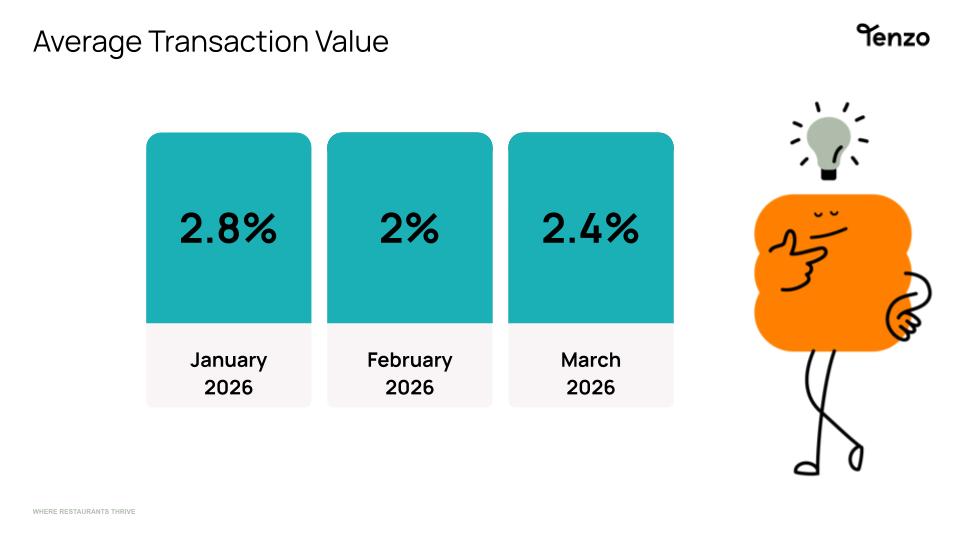
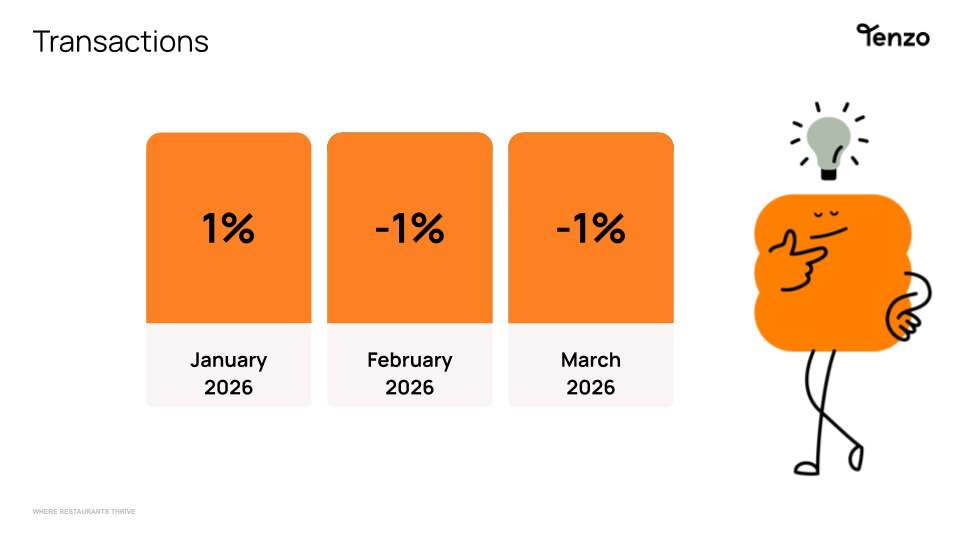
According to Tenzo’s analysis of restaurant data across the South East of England, average transaction value (ATV) has increased by 2.4% in the first few months of 2026 compared to the same period in 2025. Transaction volume year on year has remained broadly flat – up 1% in January, down 1% in February and March. Sales revenue followed a similar pattern, with a 5.6% year-on-year increase in January before levelling out closer to 2025 figures.
What this tells us is that restaurants are bringing in roughly the same number of customers, but charging more per visit. The most likely driver is menu price rises passed on by operators to protect margins. The problem is that with ingredient costs rising at the same time, spending more per transaction doesn’t mean earning more from it. With tightening margins, many operators are likely getting less out of each cover than they were a year ago.
Customers aren’t stopping eating out but they are being more deliberate about it. For example, they may choose to spend on a Friday night occasion and then skip the Tuesday lunch. For operators, that shift means value perception now does more work than price point alone.
Changes in dining-out habits
The picture that emerges from Tenzo’s South East data between January and March 2026 is nuanced. Revenue was up 5.6% year on year in January, but transaction volume only grew 1% over the same period – meaning almost all of that revenue growth came from higher spend per visit, not more visits. By February and March, revenue growth had nearly flatlined at 0.9% and 1.3% respectively, while transaction volume tipped negative.
The implication is significant. The pricing lever that operators relied on to protect margins through 2025 appears to be losing its effect. Customers are still coming through the door but in marginally fewer numbers, and they’ve absorbed about as much price inflation as they’re willing to. Revenue growth that was being driven by price rises is now stalling, and with input costs still rising, that puts renewed pressure on margins from both sides.
What can restaurants do to protect profit margins during inflation?
Even in a tough climate, the most successful operators are finding ways to boost profitability through smarter decision-making and tighter operational control.
As Christian Mouysset, Co-Founder at Tenzo, puts it: “Restaurants are affected by food, labour and energy inflation. This means they need to increase their prices to protect margins which in turn may reduce demand. It’s a tough balance to keep.”
The operators navigating that balance best are combining a few levers at once – tighter menu engineering, demand-led labour scheduling, and reducing food waste through actual-versus-theoretical tracking chief among them. For the full breakdown of each tactic, plus benchmarks by restaurant type, see our guide to restaurant profit margins.
Personalise the guest experience
When customers are more selective about where they spend, loyalty matters more than ever. Returning customers generate significantly more revenue over their lifetime than new customers, and the cost of retaining them is lower than the cost of acquiring replacements.
Using reservation and CRM systems to build a picture of your customers – their preferences, visit frequency, and spend patterns – allows you to send personalised offers that bring them back rather than generic promotions that get ignored.
Navigating inflation in 2026 and beyond
The headwinds are not easing quickly. The April 2026 NLW increase and ongoing employer NI changes mean labour cost pressure is structural, not cyclical. The restaurants that come through this period strongest will be tracking prime cost daily, adjusting labour to demand in real time, and making pricing decisions based on item-level margin data – not gut instinct. See how operators are building resilience into their margins for what’s ahead.
See how Tenzo customers are doing exactly that. Book a demo.fitability in the restaurant industry. Using restaurant data is vital in monitoring the success of business changes and tracking performance.

Supercharge your Restaurant Performance…
…with Tenzo restaurant reporting and intelligence.
FAQs
Frequently asked questions
UK food inflation is forecast to reach at least 9% by the end of 2026 according to the Food and Drink Federation, up from 3.3% in February. Combined with the April 2026 National Living Wage increase to £12.71 per hour, restaurants are facing simultaneous pressure on both their two largest cost lines at a time when customer price sensitivity limits how much can be passed on through menu pricing. For a restaurant running a standard 28–32% food cost, 9% ingredient inflation adds meaningful cost to every dish without a single recipe change.
The primary driver is global energy market disruption flowing through to food and drink manufacturing costs, alongside broader supply chain pressure from geopolitical instability. The FDF revised its 2026 forecast from around 3% to at least 9% as these pressures escalated. Food and drink manufacturing is energy-intensive, meaning cost increases hit the sector harder than most – and those increases flow through to operators as supplier contracts come up for renegotiation.
A standard food cost target sits between 28–32% of revenue for most UK restaurants. At 9% ingredient inflation, a dish that cost £3.20 to make in 2025 now costs closer to £3.49 – without any change to the recipe. Operators holding food cost within target in 2026 are doing so through a combination of supplier negotiation, waste reduction, and menu repricing rather than any single lever.
The most effective approach is demand-led scheduling – matching staffing levels to forecast demand rather than running fixed rotas. With the NLW at £12.71 and employer NI contributions also rising, operators whose prime cost was already at the top of the 55–65% healthy range need to find offsetting savings. Cross-training staff across roles adds flexibility without adding headcount, and having a plan for slow periods – prep work, delivery activations – avoids the margin and morale cost of sending people home early.
Yes, but incrementally. Small increases of 50p to £1 on best-selling dishes tend to be absorbed more easily than large single increases – and the cumulative impact is significant. A £1 increase on a dish selling 80 covers per week adds £4,000 to annual revenue before any demand impact. Menu engineering – promoting high-margin items and reviewing anything below 60% GP – often achieves as much as price rises alone, with less risk of customer pushback.
Prime cost, average transaction value, and actual versus theoretical food usage matter most – track all three daily rather than waiting for month-end reports. See the full breakdown of what to track and why.
Diners aren’t stopping eating out – they’re becoming more selective about when and where. The pattern emerging in 2026 is a shift toward weekend occasions over midweek visits, and toward casual and fast-casual over fine dining, as customers manage their disposable income by adjusting frequency and venue rather than stopping altogether. For operators, this makes value perception more important than price point – customers will spend, but they need to feel it was worth it.