Flash P&L
Glossary
Topic
In this article

Run every site like your best site
Discover Tenzo, your restaurant reporting and intelligence platform
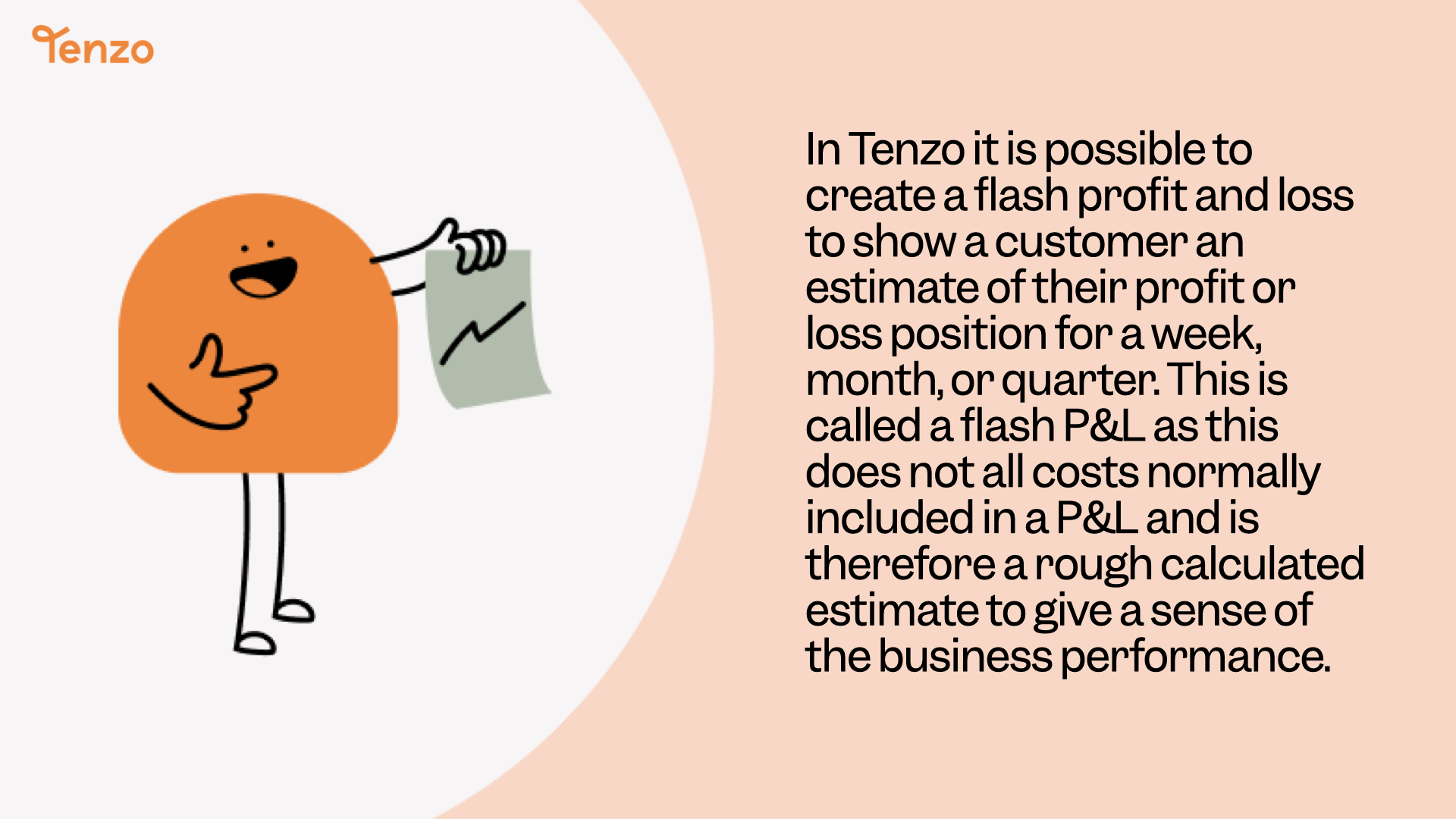
Learn moreA Flash P&L is a quick, high-level profit and loss snapshot — usually produced weekly or even daily — that tracks a restaurant’s most volatile, controllable costs: food, beverage, and labour. Unlike a full monthly P&L, it isn’t comprehensive. It’s built for speed, so operators can catch a problem while there’s still time to fix it, not a month later when the numbers finally land.
A full P&L tells you what happened. A Flash P&L tells you what’s happening. Both matter, but they answer different questions on different timelines. Here’s what a Flash P&L covers, how it differs from a full P&L, and why the speed is the entire point.
How does a Flash P&L differ from a full monthly P&L?
A monthly P&L captures every revenue line and every expense – rent, insurance, marketing, depreciation, the lot. It’s thorough, but it arrives weeks after the trading period it describes, which makes it far better for strategic review than for fixing anything in real time.
A Flash P&L trades that completeness for speed. It focuses almost entirely on prime cost – food, beverage and labour – because those are the costs that move week to week and that a manager can actually act on before the next shift. It won’t replace your monthly P&L but instead give you a read on the week you’re actually in.
What goes into a Flash P&L?
A typical Flash P&L includes:
- Sales revenue – total takings for the period, often split by day
- Cost of goods sold (COGS) – food and beverage cost as a share of sales
- Labour cost – wages and hours against the sales they supported
- Resulting margin – what’s left once prime cost is accounted for
Why does the speed of a Flash P&L matter?
Waiting until month-end to spot a problem means it’s already had four weeks to compound. A labour cost creeping up, a supplier price increase eating into margin, or a menu item quietly dragging down profitability – a Flash P&L surfaces all of these while there’s still a week left to correct course, not after the period’s closed.
This is also where prime cost data starts talking to your other numbers. A rising food cost on a Flash P&L is easier to diagnose once you know your sales mix – is it a popular item with thin margin, or a genuine cost problem? And a food cost variance is often explained by the gap between actual and theoretical usage, particularly in kitchens managing a broad menu, the way most casual dining operators do.
Related terms
FAQs
Frequently asked questions
It’s a quick, usually weekly, snapshot of a restaurant’s prime costs – food, beverage, and labour – and the margin they leave behind, designed to be produced and acted on fast rather than being fully comprehensive.
Weekly is the most common cadence, though some multi-site operators run it daily for high-value sites. Monthly defeats the purpose – by then it’s functioning as a P&L, not a flash report.
No. A Flash P&L focuses on prime cost for speed and operational control; a full P&L captures every revenue and expense line for a complete financial picture. Most operators run both, for different purposes.
Almost always food cost, beverage cost, and labour cost – together known as prime cost – since these are the costs that move fastest and that a manager can influence within the week.
Pulling prime cost together by hand from POS, supplier invoices, and rotas each week is slow and error-prone across multiple sites. Tenzo pulls this data automatically so a Flash P&L is ready without anyone assembling it manually.