
What is Restaurant Business Intelligence? The 5 Stages of Data Maturity
“ The goal is to turn data into information, and information into insight.” – Carly Fiorina, former executive, president, and chair of HP Co.
What is restaurant business intelligence?
Restaurant business intelligence (BI) is the process of turning the data your restaurants already generate – sales, labour, stock, reviews – into insight that drives better decisions. In practice, it’s the difference between knowing what happened last week and knowing why it happened and what to do next.
Every restaurant, from a single family diner to a group with hundreds of sites, is already generating a huge amount of data. Most of it goes unused. McKinsey found that a retailer using its data for analysis could increase its operating margin by more than 60% – and the same opportunity applies in hospitality.
In this article, we look at three things:
- The five stages of data maturity in restaurants
- The potential value at stake
- How to assess which stage you’re at today
The 5 stages of restaurant business intelligence
The journey from data to insight can be confusing, and most groups don’t set out with a plan. But almost every operator moves through the same five stages as they grow.
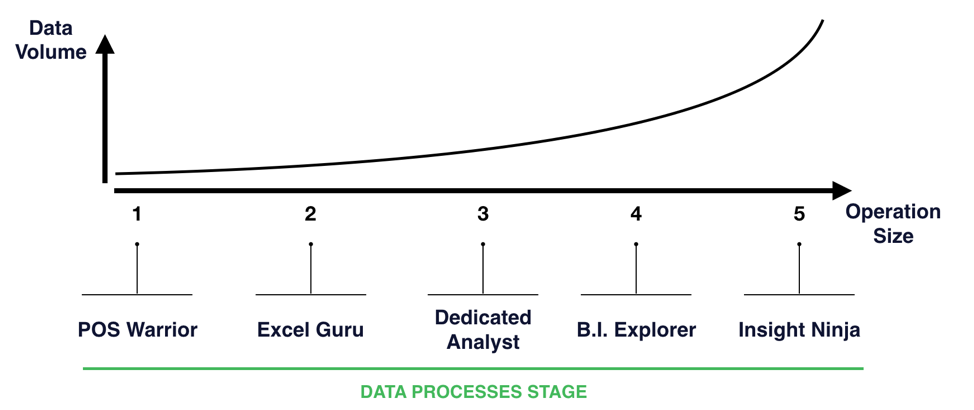
Stage 1: POS Warrior
Your POS is the single source of truth, and you rarely look at numbers beyond simple sales. That works for a single site, but it tells you what you sold, not why, and it says nothing about labour, stock or guest experience.les
Stage 2: Excel Guru
“Excel Guru” – As operations grow, data starts arriving from other systems – rota tools, stock counts, reviews – and the first tool most groups reach for is Excel. Someone spends hours every week pasting data between sheets to build reports, and by the time they land, the week has moved on.
Stage 3: Dedicated Analyst
You’re now ready to put dedicated resource on your numbers. An analyst, usually reporting to finance or operations, works from templated reports and becomes a core part of the conversation. The limit is capacity: one person can only answer so many questions, and site teams wait in a queue.
Stage 4: BI Explorer
As data volume grows, you build a central repository for your data and use third-party tools like Power BI or Tableau to visualise it for head office. Reporting becomes more reliable, but dashboards are often built for head office rather than the people running service.
Stage 5: Insight Ninja
You’ve mastered reporting and data collection, and your front-line managers now make decisions based on data every day. Insight reaches the people who can act on it, while they can still act on it – and that’s where the real value is created.
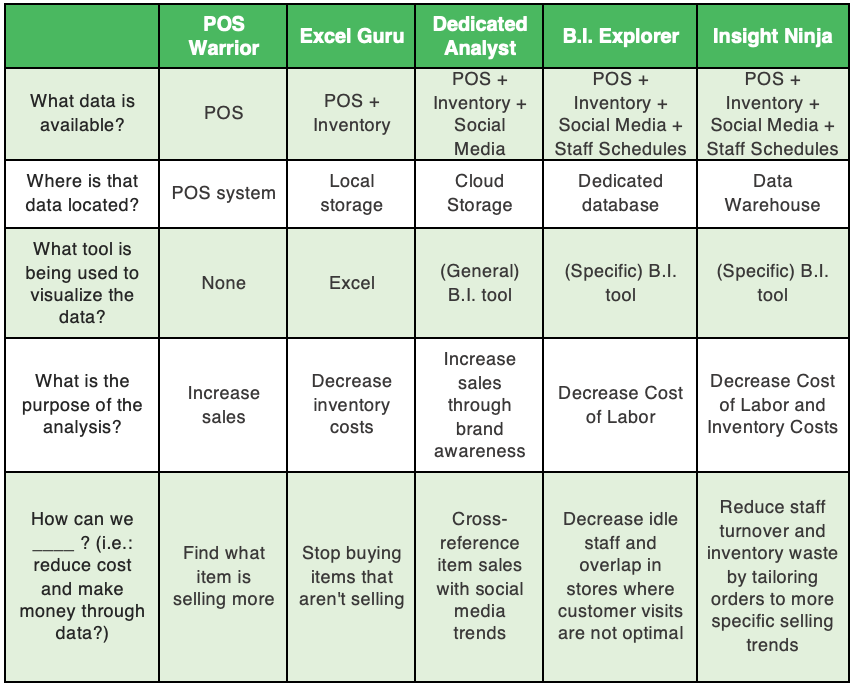
We define these stages using the following table:
We define these stages using the following table:
The potential value at stake
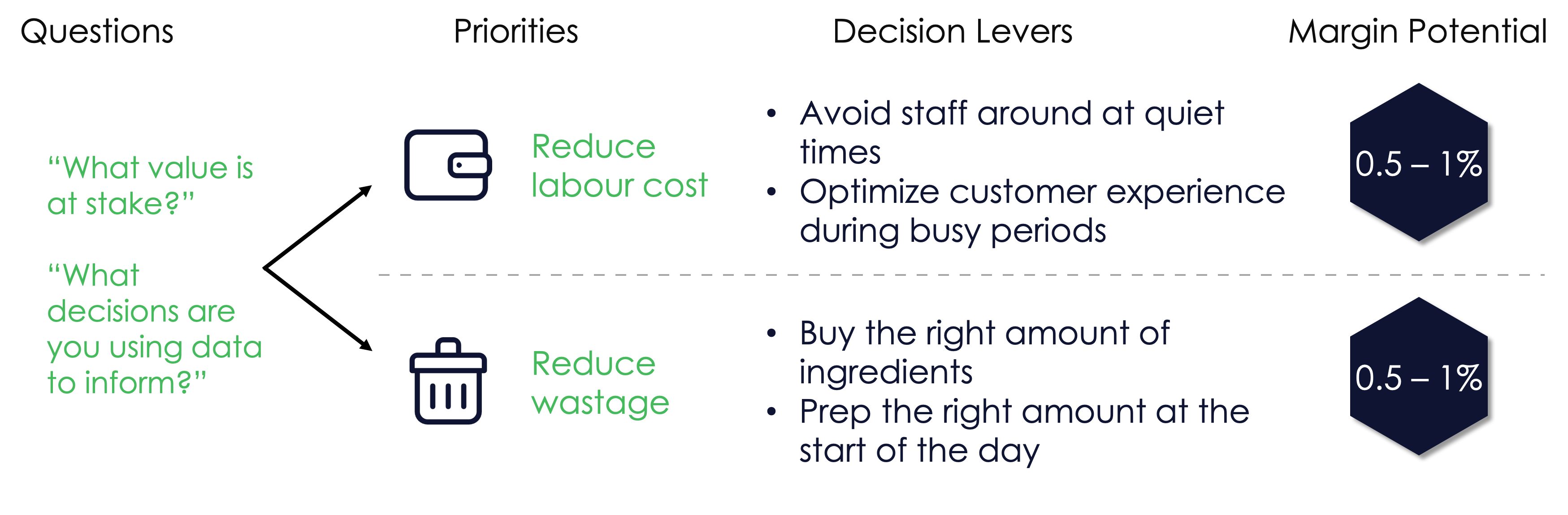
No matter where you are currently positioned, you can start to derive value from the data you have available.
First, you need to decide on your priorities. Organisations often prioritise making better decisions, improving operational efficiencies, growing revenues and increasing competitive advantage when implementing business intelligence platforms. After deciding yours, it is possible to see the following kind of value creation opportunity:
Which stage is your restaurant at?
Ask yourself:
- What data sources do you have in your business?
- Where is this data stored today, and how does it get there?
- How frequently is it updated?
- Can you ask any question you want of the data?
- How are you viewing data today?
- Are your managers taking action based on it?
- Are you seeing a positive return on what you spend on data and analytics?
How to move to the next stage
Moving up a stage rarely means more spreadsheets or more analysts. It means connecting your data sources so they can be viewed together, and putting insight in front of GMs, not just head office. Most groups see a return almost immediately once they adopt a proper data strategy.
Once you know where you sit, the next step is finding a tool that fits. Read our guide to choosing a restaurant business intelligence tool to compare your options.