

How to Choose the Right Restaurant Business Intelligence Software

In this article
- Why is business intelligence needed for restaurants?
- Problems with the current restaurant Business Intelligence tools
- Missed opportunities with restaurant Business Intelligence tools not engaging operators
- Finding the right restaurant Business Intelligence solution
- Tenzo vs. traditional Business Intelligence functionality
- Tenzo vs. traditional Business Intelligence implementations
- Conclusion
- Frequently Asked Questions
Business Intelligence (BI) tools transform restaurant operational data into insights that drive performance, but most generic BI setups – Power BI, Tableau, and similar – are built for accounting reconciliation and head-office reporting rather than the real-time, mobile-friendly insights front-line managers need. The right restaurant BI solution connects to your existing POS, labour, and inventory systems, delivers insights to both head office and GMs on the floor, and can be implemented in weeks rather than the 12+ months generic BI projects typically require.
Business Intelligence (BI) tools are focused on transforming the operational data of businesses into valuable information that can be used to improve performance. They add strategic value and a data-forward approach to the decision-making process.
If you’re thinking of implementing a restaurant Business Intelligence tool in your business, this article will explain all the aspects you need to think about.
“People buy analytics to be able to act on their data and see an impact from it” – Christian Mouysset, CEO and Co-Founder at Tenzo
Why is business intelligence needed for restaurants?
It’s no secret that Business Intelligence tools bring value to restaurants. Harnessing your restaurant data provides the roadmap and directions to controlling costs, driving growth, and as a result supercharging your profitability.
But, many Business Intelligence setups are more focused on providing accounting reconciliation and end-of-month reports rather than surfacing and delivering operational insights.
And this leaves a lot of opportunity on the table.
These limited opportunities can lead to missed chances for the business. A proper restaurant Business Intelligence setup enables front-line workers to engage with the data in order to make better daily decisions to hit targets and boost performance, while also giving back-office teams the required strategic and accounting visibility.
For example, Managers should know if next week’s staff schedules are aligned with forecasted sales and which items they’re typically over-ordering.
While Head Office should be able to measure the impact of the new happy hour and how to bring lower-performing sites up to the average.
Problems with the current restaurant Business Intelligence tools
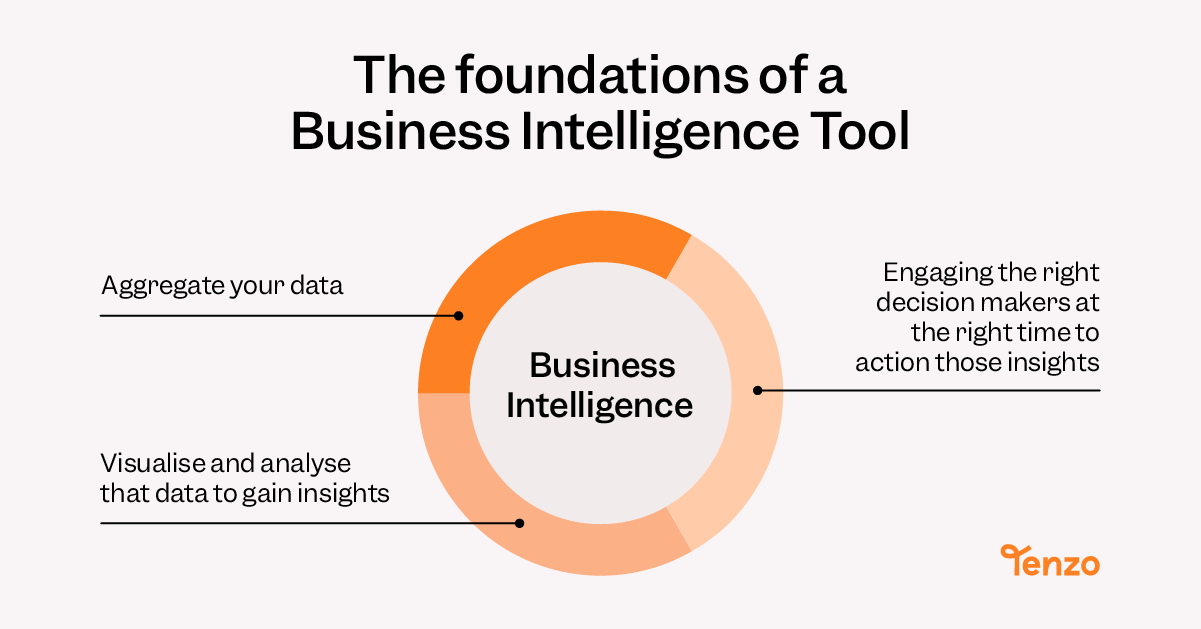
To make your organisation more data-driven, you need to (1) aggregate your data (2) analyse it and (3) engage the right decision-makers at the right time to action those insights.
Many non-restaurant-specific Business Intelligence tools, such as Power BI and Tableau tools really struggle to do (1) and (3).
Power BI and Tableau can be great for other industries but restaurants are inherently different. I.e. restaurant businesses typically don’t have large in-house IT teams with developers.
This makes piping data into these BI tools difficult. And their lack of native integrations means data is often not real-time or requires constant maintenance. Plus, it’s quite difficult to get POS tools to expose their API (if they even have one).
Even if you solve the integrations piece, Business Intelligence tools’ fixed, static views (that generally aren’t mobile-friendly) have been designed with data analysts in mind, not restaurant operators.
They don’t lend themselves to GMs on the go, and the lack of manipulative ability and ‘so what’ makes it hard for them to understand how to action the insights without going through the chain of command.
On top of this, these tools’ complexity and sophistication can cause data paralysis for many restaurant operators leading to potential overwhelm for front-line workers who already have so many fires to fight without adding complex data analysis to the mix.
Missed opportunities with restaurant Business Intelligence tools not engaging operators
To really see improvement in business performance, both head office and front-line workers need to be able to access Business Intelligence data. By predominantly focusing on head office a lot of opportunities for improving performance are missed, for example:
- Reducing food waste and stock-outs
- Deploying the right number of labour hours
- Analysing menu performance
- Improving sales performance
General managers need to be able to understand their data and be shown where they are missing these opportunities in real time in order to maximise results. This not only allows them to hit the goals above, but it also helps them align closely with their targets.
Finding the right restaurant Business Intelligence solution
Finding the right restaurant Business Intelligence tool for your business is just as important as the rest of your tech stack.
A good restaurant Business Intelligence tool is one that will grow with your business, providing you with the flexibility and scalability to grow.
It’s likely that restaurants looking to implement Business Intelligence software already have a tech stack in place with POS, labour and inventory tools, so looking for a Business Intelligence tool that integrates with multiple data sources is vital. The more sources the tool can connect to, the more visibility you’ll have over your entire business’s operations.
Aligning the data delivery capabilities of the solution with the use cases throughout your business is essential. Understanding how the tool will be used – strategically and operationally – will highlight the best options.
Operationally, finding a tool that allows those making everyday business decisions to understand insights garnered is essential in boosting performance. To provide operators with access to the correct information, ensure that it’s easily interpreted and offers real-time, fast and intuitive insights.
Tenzo vs. traditional Business Intelligence functionality
All business intelligence tools will provide useful information for businesses through access to data visualisation and many provide automated emails and allow for advanced data manipulation and report building.
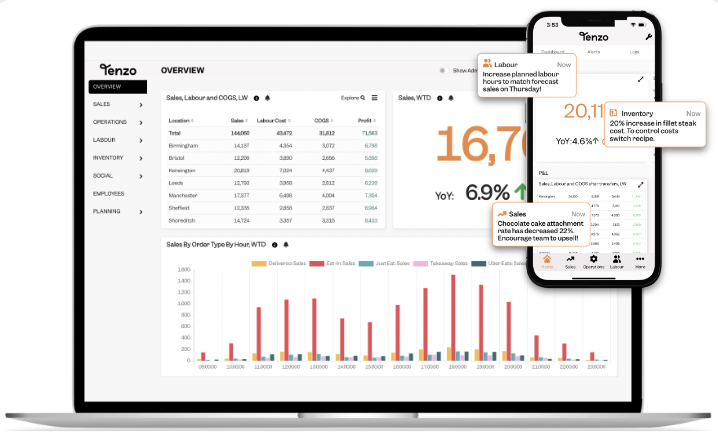
However, as already mentioned, the real difference in boosting performance comes from engaging and empowering operators. Not only does Tenzo provide depth and complexity in the drill-down reporting andAI sales forecasts for head office, but it also lends itself to operators and General managers.
Tenzo’s mobile-first, real-time approach to reporting makes it easily accessible for GMs on the move.
Tenzo is intuitive and fast in providing insights, with tailored dashboards for individual users to allow for General Manager use as well as 95% of the strategic use cases needed by head office. It can also be used as a data warehouse to feed into Business Intelligence tools such as Power BI, should this be required.
Tenzo vs. traditional Business Intelligence implementations
When considering new software, it is important to not only think about functionality but implementation as well. Generally, from the moment you sign up for the software, you’ll be paying for it, but you might not get anything out of it.
Business Intelligence tools can take up to 12 months or more to implement with no guaranteed success – they have very high opportunity costs with expensive set-up fees and ongoing expenses.
Tenzo allows you to access and gain insights from your data within weeks. We already have integrations set up allowing for immediate data aggregation and reporting so that operators can utilise their data as soon as possible.
Not only does Tenzo empower General Managers to take charge of their restaurant’s success, but the AI predictions for sales alongside GM knowledge, allow for accurate demand forecasting.
“Tenzo’s exceptional support team went above and beyond to help us optimize our operations and achieve our goals. Thanks to their robust BI platform, we were able to extract valuable insights from our data and drive our business forward. I would highly recommend Tenzo to any hospitality business looking for an analytics tool with outstanding support.” – Nora Kanawati – Head of Technology & Digital Transformation, Sisban Holdi
Conclusion
Business Intelligence is an increasingly important tool for restaurateurs, especially for large, enterprise businesses with many locations. Choosing the right tool is challenging, but we advise considering the use cases before doing so.
The best way to improve performance is by empowering operators and front-line employees to take charge of their own success. Although most Business Intelligence tools will provide the head office with strategic data delivery, Tenzo differs by allowing operators to easily engage.
Engaging front-line restaurant workers and operators by providing useful insights and a dashboard suited to them creates more opportunities for restaurateurs to supercharge their performance.
If you would like to speak to an expert, don’t hesitate to reach out for a tech consultation with the Tenzo team.
FAQs
Frequently Asked Questions
BI tools transform operational data into insights that help control costs, drive growth, and improve profitability. The value comes from acting on that data — as Tenzo’s CEO puts it, people buy analytics to see an impact from it, not just to look at numbers — so a proper BI setup needs to reach both managers deciding on staffing and stock, and head office measuring the impact of decisions like a new happy hour.
Restaurants typically don’t have large in-house IT teams, which makes piping data into these tools difficult, and their lack of native integrations often means data isn’t real-time and requires constant maintenance. Beyond setup, their fixed, static views are designed for data analysts, not restaurant operators — they aren’t mobile-friendly, don’t lend themselves to GMs on the go, and their complexity can cause data paralysis for front-line workers already juggling operational fires.
Look for a tool that integrates with your existing tech stack — POS, labour, and inventory systems — since the more sources it connects to, the more visibility you get across the business. Just as important is aligning the tool’s data delivery with how it’ll actually be used: operationally, that means insights that are easy to interpret and available in real time, not just detailed strategic reporting built for head office.
Generic BI tools can take up to 12 months or more to implement, with high setup costs and no guaranteed success — a significant opportunity cost given you’re paying for the software from day one regardless of whether you’re getting value from it. Purpose-built restaurant analytics platforms, by contrast, can have you aggregating data and generating insights within weeks rather than months.