7 Hospitality Metrics You Need to Track: Why the Metrics You Choose Matter More Than the Data You Collect

In hospitality operations, data is everywhere. But data without direction is just noise. The real competitive advantage doesn’t come from collecting more information—it comes from tracking the right hospitality metrics and KPIs that drive actionable insights and profitable decisions. Through our partnership with pointOne, we’ve identified seven critical performance indicators that forward-thinking hospitality operators across the UK, Europe, and globally are using to transform their operations.
Whether you’re managing a single-site restaurant, a café, bar, or a multi-location hospitality business, these metrics provide the foundation for operational excellence, financial control, and sustainable growth in 2026 and beyond.
The Power of Integration: pointOne + Tenzo for Hospitality Operations Management
Tracking these seven hospitality metrics manually would be overwhelming for any restaurant, café, bar, or multi-site operation. That’s where the integration between pointOne and Tenzo creates transformative value for operators across restaurants, cafés, and bars throughout the UK, Europe, and globally.
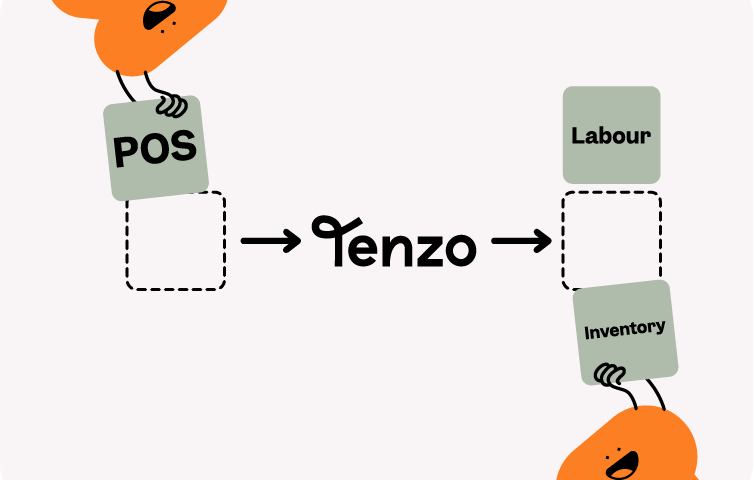
pointOne excels at the granular financial details – from precise COGS tracking with inter-location transfers to budget variance analysis. Tenzo brings powerful labour analytics, real-time operational dashboards, and predictive insights that help you schedule smarter and reduce waste in restaurant operations.
When these hospitality management systems work together, your pointOne financial data flows seamlessly into Tenzo’s operational platform. This integration delivers:
• Real-time visibility of how labour decisions impact your budget burn rate.
• Your theoretical vs. actual GP% alongside your labour efficiency metrics, giving you a complete profitability picture for restaurant operations.
• Category-level COGS insights that inform both purchasing decisions and menu engineering strategies.
• Automatic sales data updates across both platforms, ensuring everyone works from a single source of truth.
The integration eliminates double-entry, reduces errors, and most importantly, gives you the complete picture you need to make confident operational decisions. Rather than toggling between systems and manually connecting dots, you get instant clarity on what’s working and what needs attention—allowing you to focus on running exceptional hospitality operations across all your locations.
1. COGS After Transfers by Location by Category (Cost of Goods Sold Management)
Cost of Goods Sold (COGS) is a fundamental hospitality metric, but tracking it after transfers between locations and broken down by category (food, beverage, etc.) reveals the true picture of your operational efficiency across multi-site operations.
Benefit 1: Accurate Cost Allocation for Multi-Site Hospitality – When you transfer inventory between locations, basic COGS tracking can give you distorted figures. Tracking COGS after transfers ensures each location’s profitability is measured accurately, preventing one site from appearing more profitable simply because it borrowed inventory from another. This is critical for restaurant groups operating across London, Manchester, Birmingham, or multiple UK cities.
Benefit 2: Category-Level Insights for Food & Beverage Operations – Breaking down COGS by category (beverages, proteins, produce, etc.) helps you identify exactly where costs are creeping up. You might discover that whilst overall COGS looks acceptable, your beverage costs are 5% higher than they should be—allowing for targeted intervention in your bar or restaurant operations.
2. Theoretical GP% vs. Target Margins (Gross Profit Management)
Your theoretical gross profit percentage represents what your profit margins should be based on your recipes and menu pricing. Comparing this against your target margins—and actual performance—reveals operational gaps in restaurant profitability and F&B operations.
Benefit 1: Identify Waste and Shrinkage in Hospitality Operations – A significant gap between theoretical and actual GP% indicates waste, theft, over-portioning, or inventory shrinkage. This metric acts as an early warning system for restaurant managers and operations teams, allowing you to investigate and correct issues before they significantly impact profitability.
Benefit 2: Menu Engineering Opportunities for Restaurants – By comparing theoretical margins across menu items, you can identify which dishes deliver the best profitability and adjust your menu mix accordingly. Some items might be popular but underpriced; others might be perfectly priced but poorly promoted—key insights for restaurant menu optimisation.
3. Accumulating Sales vs. Budget (Revenue Tracking for Hospitality)
Rather than just comparing this month to last month, tracking accumulating sales against budget provides a running total that shows whether you’re on pace to hit your annual revenue targets—essential for restaurant chains and hospitality groups.
Benefit 1: Early Course Correction for Hospitality Business Performance – This metric tells you in real-time whether you’re tracking ahead or behind for the year. If you’re 8% behind budget by June, you know you need to take action now rather than discovering the shortfall in December when it’s too late. This is particularly crucial for seasonal hospitality businesses across the UK and Europe.
Benefit 2: Strategic Resource Allocation for Multi-Site Operations – When you’re ahead of budget, you have the confidence to invest in growth opportunities, marketing initiatives, or facility improvements. When you’re behind, you can implement corrective measures before the gap becomes insurmountable—critical for scaling hospitality operations.
4. 2026 Budget Impact on Metrics (Financial Planning for Hospitality)
As you transition into a new budget year, understanding how your 2026 budget assumptions affect key hospitality KPIs helps you set realistic expectations and spot variances early in restaurant operations.
Benefit 1: Realistic Goal Setting for Restaurant Performance – By modelling how budget changes (like planned price increases, new locations, or efficiency improvements) impact your metrics, you can set achievable targets rather than arbitrary percentage increases from last year. This is essential for hospitality businesses planning expansion across the UK, Europe, or international markets.
Benefit 2: Variance Analysis for Operational Excellence – When you understand what drove the budget assumptions, you can quickly identify whether variances are due to external factors (market conditions, inflation, rising energy costs) or internal execution issues that need addressing in your restaurant operations.
5. Labour vs. Budget Burn Rate (Labour Cost Management for Hospitality)
Labour is typically your largest controllable expense in restaurant operations. The burn rate measures how quickly you’re consuming your labour budget relative to the time period—telling you if you’re spending too fast or if you have room to invest in staffing.
Benefit 1: Proactive Staffing Decisions for Restaurant Management – If you’re burning through your labour budget faster than planned, you can make staffing adjustments now rather than facing difficult decisions at year-end. Conversely, if you’re under budget, you might choose to add staff to improve service levels or handle increased volume. This is particularly important for hospitality operations in high-cost labour markets like London, Manchester, and Edinburgh.
Benefit 2: Seasonal Planning for Hospitality Business – Understanding your burn rate helps you plan for seasonal fluctuations common in UK and European hospitality. You can deliberately over-staff during your peak season (when the revenue justifies it) and pull back during slower periods, whilst still staying within your annual labour budget.
6. Review Targets: Tracking Your Path to 4.8+ Stars (Online Reputation Management for Restaurants)
Online reviews directly impact customer acquisition for restaurants, cafés, bars, and hospitality venues. But rather than just hoping for good reviews, this metric helps you set specific targets for reaching a 4.8+ rating on Google My Business and calculate exactly how many 5-star reviews you need to get there.
Benefit 1: Concrete Goals for Restaurant Reputation Management – Instead of vaguely wanting ‘better reviews,’ you know precisely how many 5-star reviews you need. If you’re currently at 4.6 with 200 reviews and need 47 more 5-star reviews to hit 4.8, you can build specific campaigns around that target. This is crucial for competitive hospitality markets across London, Birmingham, Manchester, and major European cities.
Benefit 2: Marketing ROI for Hospitality Businesses – Research shows that a restaurant with a 4.8+ rating can command higher prices and attract significantly more customers than one at 4.5. By tracking your progress towards this threshold, you can measure the ROI of your review generation efforts and customer experience improvements.
7. Sales Per Labour Hour (SPLH) / Covers Per Labour Hour (CPLH) (Productivity Metrics for Hospitality)
These sister metrics measure productivity by showing how much revenue (or how many customers) your restaurant operation generates for each hour of labour. They’re the ultimate efficiency indicators for hospitality operations management.
Benefit 1: Operational Efficiency Benchmark for Restaurant Performance – SPLH and CPLH tell you immediately whether you’re over-staffed or under-staffed relative to your volume. A declining SPLH might indicate labour creep, whilst an increasing CPLH suggests your team is becoming more efficient at serving customers. These are critical KPIs for restaurant managers and operations directors.
Benefit 2: Location Comparison for Multi-Site Hospitality – For multi-site operators managing restaurants, cafés, bars, or hospitality venues across the UK and Europe, these metrics enable apples-to-apples comparison across locations with different layouts, concepts, or check averages. A location with £45 SPLH is likely more efficiently staffed than one at £35 SPLH, regardless of their total sales volumes.
Real Results from Real Operators
So how have these metrics helped operators supercharge their business? The Director of Operations at Lina Stores, a multi location casual dining group, puts it best:
“What I love about having pointOne and Tenzo working together is that I finally have one version of the truth. From Sales per Labour Hour across our sites to tracking how close we are to hitting our review targets, everything is in one place. It’s not just about the data, it’s about the confidence it gives you to run your business properly.”
“Managing multiple sites used to mean drowning in spreadsheets trying to compare like for like. With pointOne and Tenzo, I can see Sales Per Labour Hour across every location instantly. It’s made my site managers more accountable and my conversations with them much more focused.”
The Bottom Line: Essential Hospitality Metrics for 2026
In hospitality operations, the difference between thriving and merely surviving often comes down to knowing what to measure and having the systems to track it accurately. These seven hospitality metrics and KPIs – from COGS after transfers to labour burn rate to online review targets – provide the foundation for operational excellence across any restaurant, café, bar, or multi-site hospitality business in the UK, Europe, and beyond.
But metrics alone aren’t enough for successful hospitality management. You need the right hospitality technology to track them efficiently, the right integration to connect your systems, and the right insights to know what actions to take. That’s what pointOne and Tenzo deliver together for restaurant managers and operations teams: not just data, but clarity, confidence, and the competitive advantage your operation needs in 2026.Because at the end of the day, it’s not about having more hospitality metrics, it’s about tracking the right ones for your restaurant, café, bar, or hospitality business.