
What can AI do for restaurants in 2026?

In this article
- How can AI add value to restaurants in 2026?
- Where AI falls short and what it should never replace
- What does 'AI-powered' actually mean for restaurant software?
- The data problem most restaurant operators don't realise they have
- How Tenzo MCP changes what's possible for restaurant operators
- Frequently Asked Questions

Want to dive into your data?
Looking to get the most out of your business' data? Let's chat!
Request a demoIn 2026, AI for restaurants creates real value in the right places – reading sales patterns, forecasting demand, flagging labour variances, and answering operational questions in plain English. What it can’t do is replace the judgement of people who actually run restaurants, paper over fragmented data, or take action on your behalf. Most operators already have everything AI needs. The problem is it’s spread across five different tools that have never been introduced to each other.
In 2026, restaurateurs are just as concerned with AI as they are with their covers.
So the question most operators are actually asking isn’t “What is AI?” but instead, “Is this relevant to my business right now, and should I be doing something about it?”
Below, we map out where AI creates genuine value for restaurant operators in 2026, where it’s being oversold, and the data problem that’s quietly limiting most multi-site groups from getting true value out of it.
How can AI add value to restaurants in 2026?
There’s a lot of noise around AI right now, and most of it isn’t aimed at people running restaurants. So let’s be specific about where the value is real in hospitality.
1. How does AI help restaurants analyse performance across multiple sites?
Picture what a good analyst could do with a week, and access to your entire tech stack: your POS data, your labour records, your review scores etc. They’d come back telling you which sites are quietly bleeding margin, which dishes aren’t pulling their weight, which shifts are chronically overstaffed. Genuinely useful information that takes time – a lot of CSV exports, a lot of spreadsheet wrangling – and by the time the analysis lands, the window to act on it has usually closed.
AI does the same thing faster. But the more important advantage isn’t speed. It’s scale. Once you’re running more than three or four sites, the volume of analysis required doesn’t grow linearly – it compounds. No analyst team keeps up with it manually. AI does, regardless of how many sites you’re running, and without needing you to already know what questions to ask.
2. How does AI demand forecasting work for restaurants?
AI demand forecasting builds a picture of what a given shift looks like before it happens – drawing on your historical sales, covers data, and seasonal patterns to generate a forecast that drives your labour schedule, your prep quantities, and your purchasing decisions to name a few.
Done properly, it replaces the ‘gut feel plus last week’s numbers‘ approach that most groups are still relying on. And with it, the over-ordering and overstaffing that quietly chip away at margin, week after week.

“The number that we’ve saved on our labour is in the hundreds of thousands of pounds.”
Read Camino’s case study.
3. How can AI flag cost and labour problems before month end?
Most operators find out about a cost problem when it lands in the P&L. By then, the damage is done.
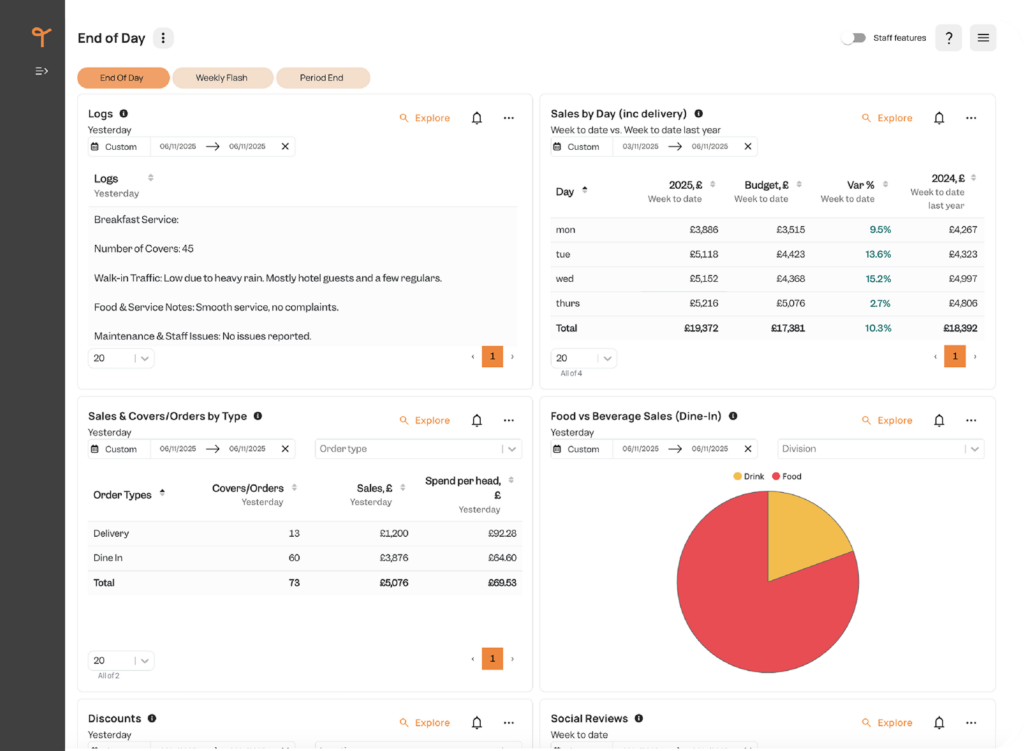
AI analytics can flag when a site’s labour percentage, food cost, or review score drifts outside its normal range – while there’s still time to act on it.
That’s the difference between a report and an alert. Reports tell you what happened. Alerts tell you what’s happening now.
4. Can AI answer operational questions in plain language?
This is where the shift is most noticeable and where tools like Tenzo’s MCP are changing what’s actually possible for operators day to day.
Most reporting workflows look like this: you have a question, you go to your BI tool, you build or pull a report, you try to find the answer somewhere inside it. If the question cuts across two data sources – such as labour and covers on the same nights – you’re probably exporting to Excel and doing it yourself.
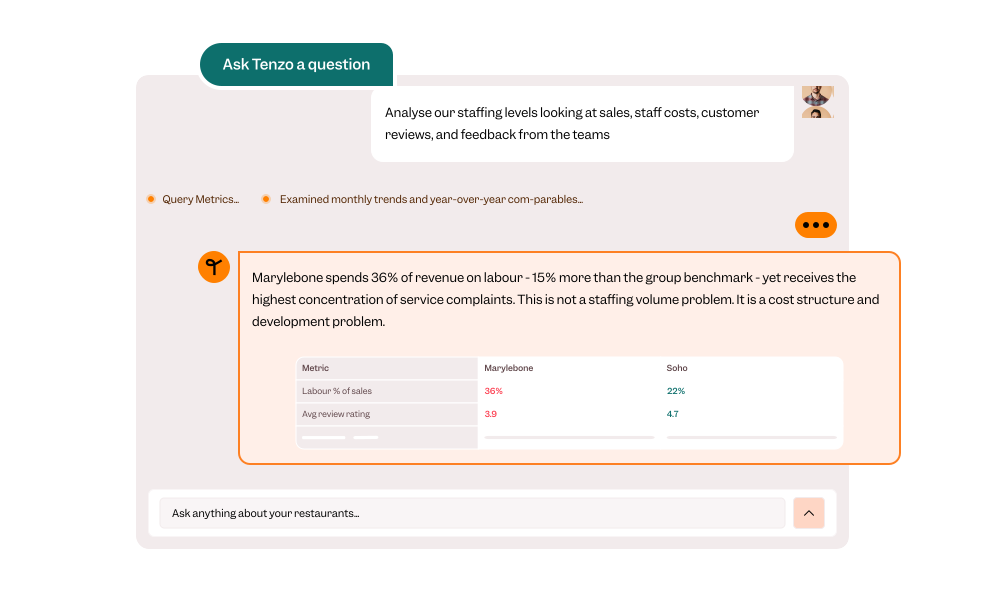
With an AI tool connected to your operational data, that workflow disappears. You ask the question in plain English – ‘Which of my sites had the worst labour cost last quarter?’ or ‘On my busiest Friday nights, what does spend per head look like compared to quieter ones?’ – and get a direct answer, with your actual numbers behind it, in seconds.
The reason this matters more than it sounds: the questions operators most need to answer are almost always multi-source questions. Labour and covers. Sales and reviews. Spend per head and day of week. Those questions are hard to answer today because the data lives in separate tools that don’t talk to each other. An AI layer connected to your entire tech stack doesn’t just save time, it makes whole categories of questions answerable that currently aren’t.
Where AI falls short and what it should never replace
For all the things AI genuinely does well, there are limitations that tend to get glossed over in the excitement. They’re worth understanding before you build your operations around it.
1. AI informs operational judgement. It doesn’t replace it.
An AI can tell you that labour cost ran 4 percentage points over plan last Tuesday at your Manchester site. It can’t tell you that a supervisor no-show triggered multiple issues that your GM then handled brilliantly – in a way that deserves to be noted, replicated, and recognised.
The operational context, the people knowledge, the on-the-ground reality – that still lives with your team. Tenzo’s MCP can learn your business over time from the information you feed into it and the information you supply in your day-to-day logs. But the calls remain yours. AI surfaces what you need to make better decisions. It doesn’t make them for you.
2. AI is only as useful as the data you give it
If your POS data is inconsistent, your labour inputs are patchy, or your review data isn’t being captured cleanly, the AI output reflects that exactly. A sophisticated model on top of poor data doesn’t produce sophisticated insights – it produces confident-looking nonsense.
The operators who get the most from AI are the ones who’ve already done the unglamorous work of cleaning and connecting their data sources. AI amplifies what’s there. It doesn’t fix what’s broken.
3. AI can’t act on your behalf – and that’s fine
Outside narrow, well-defined automations, AI doesn’t act – it surfaces, answers, and flags. The execution stays in your hands and the decision remains with you. Given what’s at stake in running a hospitality business, that’s exactly how it should be.
What does ‘AI-powered’ actually mean for restaurant software?
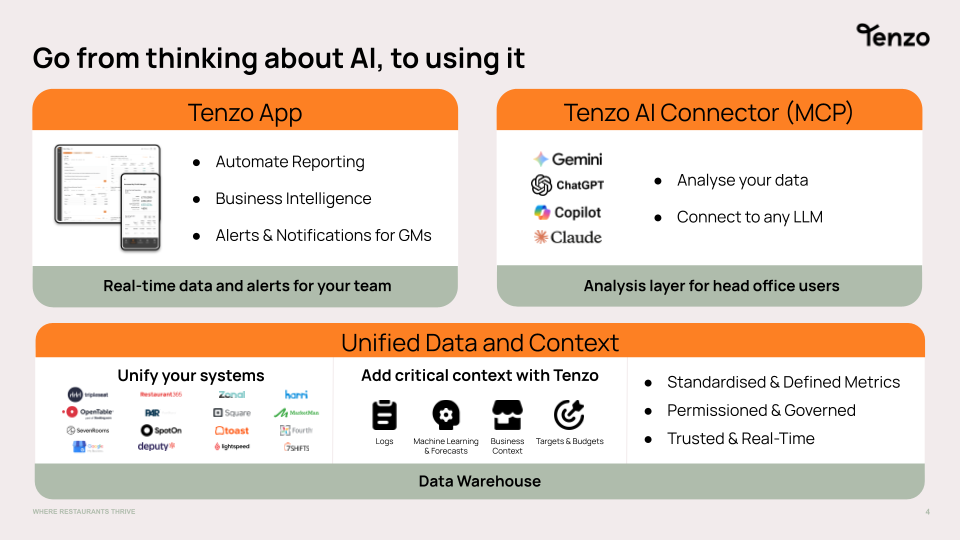
A significant number of tools currently marketed as ‘AI-powered’ are standard BI dashboards with a chat interface dropped on top. You type a question, it queries its one data source, and returns a number you could have found by clicking three times.
That’s not nothing but it’s a long way from what AI can actually do when it’s working across a properly connected data model. The distinction matters when you’re evaluating tools, and it’s one most vendors aren’t volunteering. Tenzo MCP queries each connected data source simultaneously, rather than a single slice of your operation. See it in action here.
The data problem most restaurant operators don’t realise they have
Here’s the structural issue that quietly limits what AI can do for most multi-site groups.
The average operator runs somewhere between five and fifteen separate software tools: POS, labour scheduling, inventory, reservations, review platforms, manager logs. Each one holds a piece of the picture. Standing alone, none of them hold the full story.
The insight you actually need almost always lives in the join between two or more of those sources.
Take a question any operator would recognise: ‘Why are my review scores lower on Fridays?’ To answer it properly, you need labour data (were you understaffed?), covers data (were you over-capacity?), and review sentiment, all from the same Friday nights. If those three sources aren’t connected, no AI tool can answer it. It can only answer the parts it can see.
That’s the gap limiting most operators right now. It’s not a question of whether AI is sophisticated enough. It’s whether enough of your data is connected to give it something real to work with.
How Tenzo MCP changes what’s possible for restaurant operators
This is exactly the problem Tenzo’s MCP (Model Context Protocol) was built to solve.
Most BI tools work with one data source – one slice of your operational picture. With Tenzo MCP, you ask the question in plain English, in whichever AI tool you already use – ChatGPT, Claude, Gemini, Copilot – and get a joined-up answer drawn from all your connected data sources at once.
This means questions that would previously have needed a multi-step manual analysis, or a week spent in Excel, become answerable in seconds.
‘On my worst-reviewed days, what did labour, covers, and spend per head look like?’ That’s now a one-line question.
If you’d rather see it than read about it, book a demo and we’ll show you exactly what Tenzo MCP can surface for your group, using your data.
FAQs
Frequently Asked Questions
AI for restaurants refers to software that uses machine learning and large language models to analyse operational data – sales, labour, covers, inventory, reviews – and surface patterns, forecasts, and answers that would take a human analyst far longer to produce. The practical applications today include demand forecasting, labour variance analysis, menu margin analysis, and plain-language querying of your own operational data.
Multi-site groups get the most value, because tracking performance across many sites at once is exactly the problem AI is good at. The highest-ROI applications are demand forecasting – which reduces both over-staffing and over-ordering – and labour variance detection, which catches cost drift before it shows up in the monthly P&L. Single-site operators can benefit too, particularly if their data is well-connected.
Standard restaurant analytics tools show you what happened – they surface your numbers in a dashboard. AI-powered tools let you ask why it happened and get a joined-up answer from multiple data sources at once. The practical difference: instead of building a report, you ask ‘why were my review scores lower on Friday nights last quarter?’ and get an answer that draws on labour, covers, and review data simultaneously.
Not entirely, and probably not soon. What AI changes is the volume of routine analysis that requires human time – pattern-spotting, report generation, and answering repeat operational questions. The analytical work that requires context, judgement, and knowledge of your specific team and sites still needs a person. The practical effect for most groups is that existing analytical capacity goes further, rather than being replaced.
At minimum, clean and consistent POS data (sales and covers) plus labour data. From there, each additional source – inventory, reviews, reservations, manager logs – unlocks more cross-domain analysis. The key word is connected: data sitting in separate tools without a unified layer can only be analysed in isolation, which limits what AI can tell you.
Both, depending on the application. The hype is real – there are a lot of ‘AI-powered’ tools that are standard reporting with a chatbot UI. But the genuine value is also real, particularly for operators who have already unified their data sources. The operators seeing real results are the ones who’ve been specific about the problem they’re applying AI to – not the ones who bought a platform and hoped it would surface insights automatically.
The operators getting real value from AI for restaurants in 2026 aren’t the ones who’ve invested in the most sophisticated tools. They’re the ones who’ve connected their data, asked specific questions, and used AI to answer them faster than any analyst could.
Want to see what that looks like with your own data? Book a demo and we’ll show you exactly what Tenzo MCP can surface for your group.