

A guide to choosing the right technology for your hospitality business
In this article
- 1. Start with Operational Pain Points
- 2. Focus on Integration Across Departments
- 3. Prioritise Automation Without Losing Control
- 4. Evaluate Ease of Use and Training Needs
- 5. Measure Impact with Operational KPIs
- 6. Choose Reliable, Hospitality-Specific Vendors.
- 7. Pilot, Train, and Iterate
- Final Thoughts
- Frequently Asked Questions
Choosing the right technology for a hospitality business comes down to seven steps: start from your actual operational pain points rather than shiny features, prioritise integration across departments so systems share data automatically, automate routine tasks without losing human oversight, evaluate how easily your team can actually use the system, measure impact with clear operational KPIs, choose vendors who understand hospitality specifically, and roll out new tools in stages rather than all at once.
The hospitality industry runs on details – from scheduling and managing stock to streamlining workflows. In an era where margins are tight and guest expectations are sky-high, technology has become a vital tool for operational success.
But with so many solutions on the market – from point of sale (POS) to workforce scheduling tools – how do you know which technology will truly enhance your operations rather than add complexity?
Here’s a practical guide to selecting the right technology for your hospitality operations.
1. Start with Operational Pain Points
Before exploring technology providers, take a close look at your current operations.
- Where do delays or bottlenecks occur?
- Which processes still rely on manual input or paper records?
- What’s driving most guest complaints?
For example:
- If you’re unsure where your growth opportunities lie, investing in analytics software could provide the insights you need.
- If your team spends hours each week creating rotas, an automated workforce management system can save time and reduce errors.
Start with what’s broken — then find technology that fixes it.
2. Focus on Integration Across Departments
Every department, from front-of-house to finance, relies on the same flow of information: sales, stock levels, staffing, and supplier data. When systems operate in silos, the result is wasted time, duplicated effort, and costly mistakes.
Look for technology that:
- Integrates easily with your existing systems (via APIs or built-in connectors)
- Syncs data between departments automatically
- Reduces the need for double-entry or manual reconciliation
Example: An integrated ordering and inventory system automatically adjusts stock levels when an order is placed, reducing the risk of overselling and improving menu accuracy.
But why stop at just integrating two systems?
Integration in Action: A Real-World Example
Imagine a multi-site restaurant brand using an integrated tech stack:
- A guest books a table through the online reservation system.
- The booking automatically updates the POS and pre-orders are flagged in the kitchen management system.
- When the meal is served, the POS deducts ingredient quantities from stock in real time.
- Reporting tools receive daily sales figures automatically, while the inventory tool suggests the next supplier order based on current stock and sales trends.
- Head office’s dashboards show performance across all sites — from sales to labour to waste — without a single spreadsheet update.
And you guessed it – Tenzo can facilitate your integrated tech journey by connecting your sales, labour, inventory, reservations, and reviews to get meaningful insights in a dashboard format, helping optimise your operations.
The outcome?
- Consistent data, fewer errors, faster reporting, and better decision-making across the board.
3. Prioritise Automation Without Losing Control
Automation isn’t about removing the human touch; it’s about freeing your staff to focus on higher-value tasks.
Consider tools that automate:
- Forecasting demand
- Maintenance requests and stock management
- Employee shift scheduling and time tracking
- Guest communication workflows (e.g. pre-arrival messages, post-stay feedback)
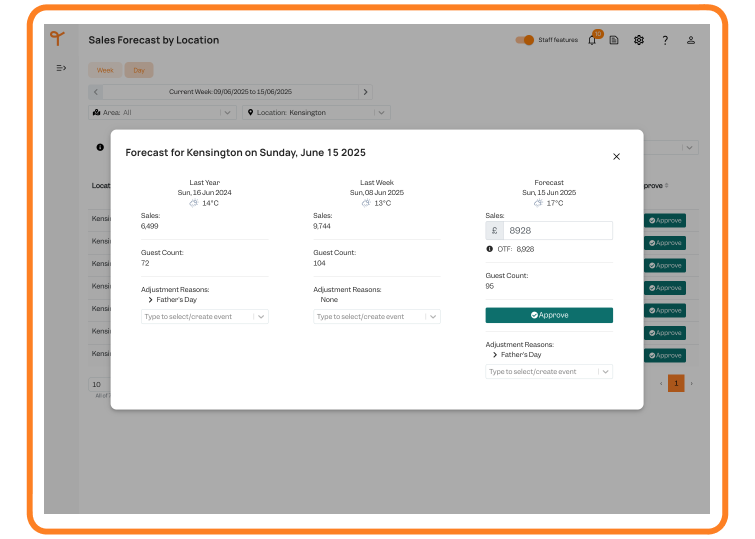
However, ensure automation doesn’t come at the expense of flexibility. In Tenzo, you can generate forecasts based on historical data, seasonality, weather, national and local events, but they require general manager approval to provide human context, e.g. road works that will impact sales for accurate forecasts. Once forecasts have been set in Tenzo you can push these forecasts into your scheduling tool for a frictionless process.
By automating the routine, you give your teams more time to focus on quality, service, and guest experience.
4. Evaluate Ease of Use and Training Needs
An advanced system is useless if your team can’t use it effectively. When choosing operational technology, usability should be a top priority.
Ask providers to demonstrate:
- Mobile functionality (can operators respond to their needs from their phones?)
- Ease of onboarding (how long to train a new hire and how much training does the platform provide?)
- Multilingual support (especially for diverse hospitality workforces)
- Role-based permissions (so staff only see what’s relevant to them)
A good benchmark: If your staff can’t confidently use the system after one training session, it’s too complex.
With high staff turnover and seasonal teams, simple systems reduce training time so new starters are confident within days, not weeks. And when everyone uses tools consistently, errors drop, data improves, and guest experiences stay seamless.
5. Measure Impact with Operational KPIs
Introducing new technology is only the first step — the real value lies in how effectively it improves performance. To understand whether your investment is paying off, you need to measure its operational impact using clear, relevant Key Performance Indicators (KPIs).
Without measurable goals, technology risks becoming just another expense rather than a driver of efficiency and profitability. KPIs help you move from gut feeling to data-driven decision-making — allowing you to track progress, fine-tune processes, and demonstrate ROI across your business.
For example:
| Area | KPI | Outcome |
Kitchen Operations | Average ticket time | Average ticket time 20 minutes |
Labour Management | Labour cost as % of revenue | Labour cost as % of revenue to be reduced by 2% |
Revenue & Profitability | Average spend per cover / gross profit margin | Increase by 10% |
These metrics help you track ROI, justify expenditure, and fine-tune your technology stack over time. Measuring KPIs isn’t a one-off exercise. It’s about creating a continuous feedback loop. Set a baseline before you implement new technology, then compare data at regular intervals — weekly, monthly, or quarterly depending on the metric.
6. Choose Reliable, Hospitality-Specific Vendors.
Not all technology providers understand the complexities of hospitality operations. They’ll speak your language — and understand the realities of 24/7 operations, high staff turnover, and strict service standards.
Before committing, check:
- Integration compatibility lists; ensuring your tech scales with your needs and is future proof.
- Case studies with similar-sized properties; prov
- SLA terms for uptime and support response times
- Availability of local or regional support
Pro tip: Ask for references from other operations leaders — their feedback is often more revealing than a product demo. Alternatively, a quick search on Trustpilot will help provide a broad sample size of user experience beyond your immediate network. Nothing worse than finally choosing a piece of software and not delivering, often causing more problems and causing you to be stuck with an underwhelming solution or restart the whole process again.
7. Pilot, Train, and Iterate
Roll out new technology in stages rather than all at once. Start with one department or one property. Monitor adoption, collect feedback, and measure the impact before scaling.
Don’t treat technology deployment as a “set it and forget it” project. Operational technology requires continuous improvement — updating processes, retraining teams, and revisiting configurations as your business evolves.
Final Thoughts
Choosing the right technology for hospitality operations isn’t about chasing innovation — it’s about building efficiency, reducing friction, and empowering your people.
When evaluating solutions, think beyond features and focus on how each system supports:
- Real-time visibility into operations
- Data-driven decision-making
- Seamless collaboration between departments
The right technology doesn’t just improve workflows — it strengthens the foundation of great hospitality: consistency, responsiveness, and excellence in execution.
FAQs
Frequently Asked Questions
Start by identifying your actual operational pain points – where delays happen, what still relies on manual input, what’s driving guest complaints – rather than shopping by feature list. From there, prioritise systems that integrate across departments, automate routine work without losing flexibility, are easy for staff to actually use, and can be measured against clear KPIs once live.
Every department – front-of-house, finance, operations – relies on the same underlying data: sales, stock levels, staffing, and supplier information. When systems operate in silos, the result is wasted time, duplicated effort, and costly mistakes, whereas an integrated stack lets data sync automatically, e.g. an order updating inventory in real time without manual reconciliation.
Track clear, relevant KPIs before and after implementation rather than treating it as a one-off check — for example, average ticket time in kitchen operations, labour cost as a percentage of revenue, or average spend per cover. Set a baseline before rollout, then compare at regular intervals (weekly, monthly, or quarterly depending on the metric) to justify spend and fine-tune the stack over time.
Choose vendors who understand hospitality specifically – 24/7 operations, high staff turnover, strict service standards – rather than generic software providers. Before committing, check integration compatibility, case studies from similarly-sized properties, SLA terms for uptime and support, and reference feedback from other operations leaders rather than relying on a product demo alone.
No – roll it out in stages, starting with one department or one property, monitoring adoption and collecting feedback before scaling further. Technology deployment isn’t a “set it and forget it” project; it needs ongoing retraining and reconfiguration as the business evolves.